TL;DR:
- Mobile beauty services in skilled nursing facilities improve residents' mood, dignity, and cooperation with care. Verified, trained providers adapt their techniques to support residents with mobility and cognitive challenges, enhancing quality of life. Platforms like VÉLOURA streamline scheduling, vetting, and billing to ensure safe, reliable service delivery.
A skilled nursing beauty service is an on-site or mobile program that brings licensed hair, nail, makeup, lash, and skincare professionals directly into a skilled nursing facility to deliver resident-centered grooming and personal care, either in a dedicated salon space or at the bedside. For residents, it is one of the most consistent sources of dignity, routine, and genuine human connection available inside a care setting. For administrators ready to move forward: start by requesting proof of cosmetology licensure and professional liability insurance before any provider sets foot on the floor.
Table of Contents
- What services are included, and how are they adapted for residents?
- Why do these services matter for residents, families, and your team?
- How do on-site beauty services actually operate inside your facility?
- What safety, licensing, and infection-control checks should you require?
- What billing and booking models work best for skilled nursing facilities?
- What should you ask every provider before approving them?
- How do you adapt services for residents with dementia or mobility challenges?
- How do you launch a pilot beauty program in 7 steps?
- Key Takeaways
- Why senior-focused mobile beauty deserves more than an afterthought
- VÉLOURA Beauty On Demand brings vetted mobile beauty to your facility
- FAQ
What services are included, and how are they adapted for residents?
The core menu for nursing home beauty care covers haircuts and styling, shampoo and conditioning, color services when medically appropriate, manicures and pedicures, basic makeup application, skincare, and short scalp or hand massages. Each one can be adapted for the realities of a skilled nursing environment.
Practical adaptations include:
- Portable sinks and dry-shampoo systems for residents who cannot transfer to a wash station
- Seated and bedside techniques so services reach residents with limited mobility or those on bed rest
- Waterless and low-chemical products that reduce aspiration risk and skin sensitivity
- Shorter service formats (20–30 minutes) calibrated to cognitive load and fatigue
- Low-ammonia or ammonia-free color options for residents whose nursing team has cleared chemical services
Always coordinate with nursing staff before scheduling chemical color or any service involving heat tools near medical devices. A resident's care plan may include contraindications that are not visible to an outside provider.
Why do these services matter for residents, families, and your team?
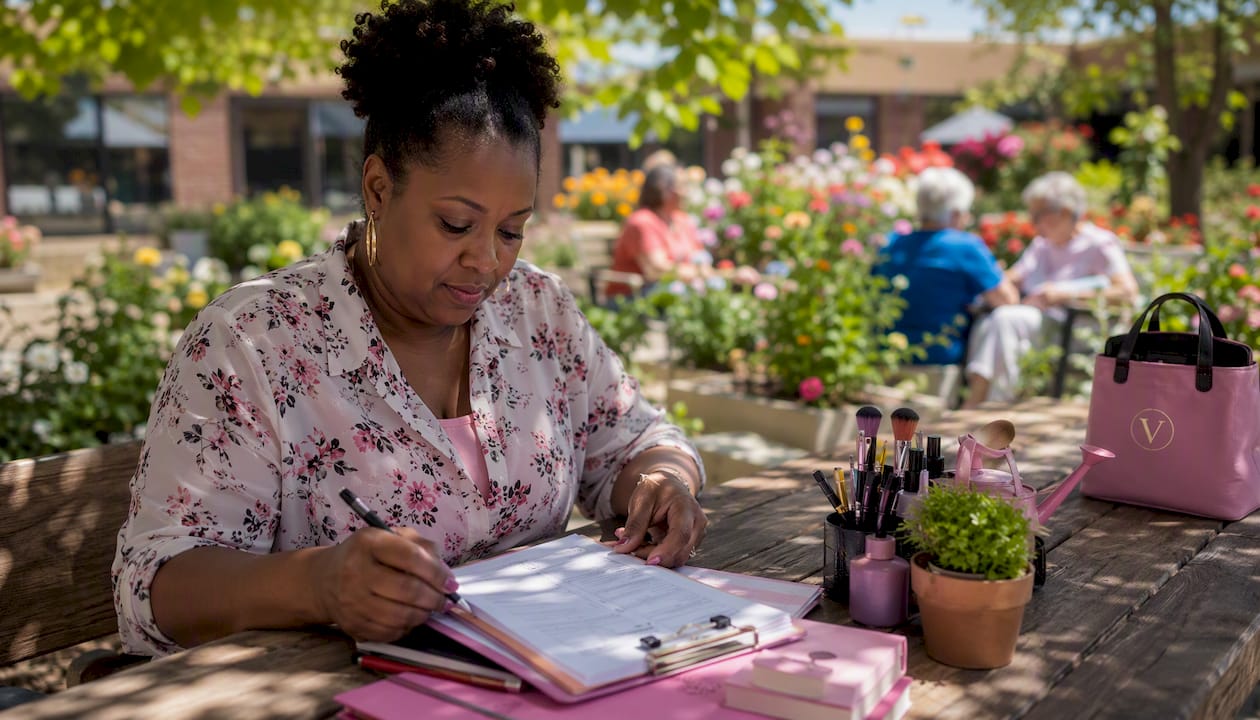
The evidence is clear. Research on cosmetic therapy in nursing-home settings found significant improvements in mood, satisfaction, motivation, comfort, and vigor after a single session. Those are not minor quality-of-life gains; they translate into lower agitation, fewer behavioral incidents, and residents who are more cooperative with clinical care.
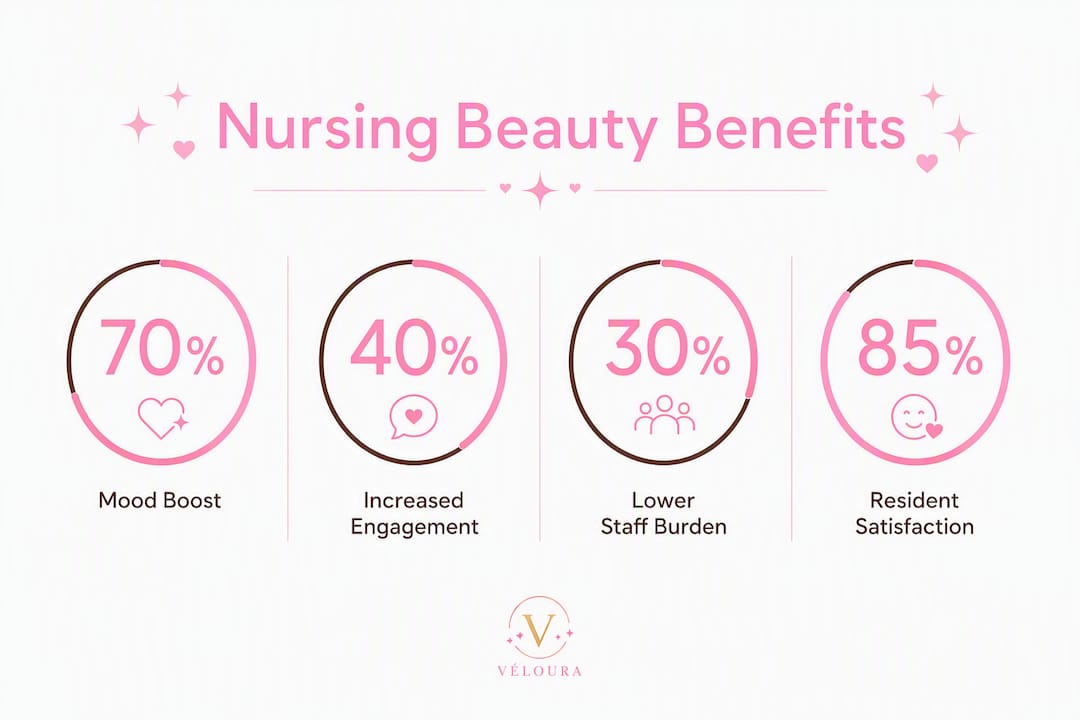
Beyond the data, grooming restores something harder to measure: agency. Choosing a nail color or asking for a specific haircut is one of the few decisions many residents still control. That moment of choice matters. Families notice it too. When a resident looks and feels cared for, family satisfaction rises and complaint volume tends to drop.
For your care team, a well-run beauty service for elderly residents also reduces transport requests and the staffing burden that comes with off-site salon trips.
Pro Tip: Track resident mood and engagement scores on the days beauty services are scheduled versus days they are not. Even a simple two-week comparison gives you concrete data to justify the program to leadership or a budget committee.
How do on-site beauty services actually operate inside your facility?
A typical visit follows a predictable flow: a resident or family member submits a request, the coordinator schedules within an open shift window, nursing reviews the care plan and flags any contraindications, the provider arrives and sets up in the salon or at the bedside, delivers the service, and a brief note is added to the resident's record.
Mobile beauty professionals who specialize in care settings often handle 25–50 appointments per week across multiple facilities, which means their equipment is purpose-built: portable chairs, folding wash basins, cordless tools, and privacy screens. That level of preparation is a good signal when you are vetting a provider.
Space and scheduling considerations:
- A dedicated salon room is ideal but not required; a private corner with a power outlet works for most services
- Schedule beauty visits outside peak medication and therapy windows, typically mid-morning after rounds
- Confirm informed consent with the resident or their legal representative before each visit
- Establish a clear emergency-stop protocol: any provider working in your facility should know exactly who to notify and how
Pro Tip: Ask providers to share their weekly schedule template before the first visit. Providers who already build in buffer time between residents and coordinate with therapy departments are far easier to integrate than those who treat the facility like a walk-in salon.
What safety, licensing, and infection-control checks should you require?
Facilities get the most consistent results when vendors supply complete documentation upfront. The table below shows the minimum verification set.
| Verification Item | What to Request |
|---|---|
| Cosmetology or barber license | Current state license, valid in your state |
| Background check | Criminal background check |
| Professional liability insurance | Certificate of insurance, minimum $1M per occurrence |
| CPR/first aid certification | Current card, especially for providers working with high-acuity residents |
| Product safety documentation | MSDS/SDS sheets for all chemical products used on-site |
| Infection-control protocol | Written procedure for tool sanitization and single-use implement policy |
Beyond the table, require providers to align with your facility's active infection-control policies, including any COVID-19 or flu protocols. Licensed mobile beauty professionals who work regularly in care settings will already have these documents ready. Hesitation to provide them is a disqualifying signal.
Key contract clauses to include:
- Indemnity and insurance limits with your facility named as additional insured
- Written scope of services (what the provider will and will not do)
- Emergency-stop and medical-clearance language
- Infection-control responsibilities assigned to the provider in writing
What billing and booking models work best for skilled nursing facilities?
Three models dominate how facilities handle payment for beauty services in nursing settings.
| Model | How It Works | Best For |
|---|---|---|
| Resident pays direct | Resident or family pays the provider at time of service | Facilities with engaged families and residents who manage personal funds |
| Facility amenity | Facility covers cost as part of the care package | Facilities competing on quality of life and resident satisfaction scores |
| Turnkey vendor/marketplace | A third-party platform handles booking, payment, vetting, and continuity | Administrators who want low overhead and consistent provider quality |
The turnkey model is where platforms like VÉLOURA Beauty On Demand add the most value. Instead of managing individual provider contracts, verifying credentials manually, and chasing cancellations, your coordinator makes one request and the platform handles the rest: background-checked and licensed professionals, secure payment processing, and a continuity plan when a regular provider is unavailable.
What should you ask every provider before approving them?
Use this checklist before signing any vendor agreement or allowing a first visit.
Pre-service questions:
- Can you provide your current state cosmetology or barber license?
- Do you carry professional liability insurance? Can you name our facility as additional insured?
- Do you have experience working with residents who have dementia or limited mobility?
- What is your cancellation and no-show policy?
- Can you provide two facility references?
- Will you share MSDS/SDS sheets for every product you plan to use on-site?
Contract clauses to request:
- Indemnity language covering incidents during service delivery
- Explicit scope of services with exclusions listed
- Infection-control responsibilities assigned in writing
- Emergency-stop procedure and escalation contacts
- Cancellation terms with minimum notice requirements
How do you adapt services for residents with dementia or mobility challenges?
Cognitive and physical limitations call for a different approach, not a reduced one. The goal is a calm, predictable experience that the resident can anticipate and trust.
Practical adaptations that work:
- Offer two choices maximum ("Would you like a trim or just a style?") rather than an open menu
- Introduce yourself by name and role before touching the resident
- Use quieter tools: cordless clippers, low-heat dryers, and battery-powered devices reduce sensory overload
- Keep sessions short and consistent; the same provider at the same time each week builds familiarity
- Position mirrors selectively; some residents with advanced dementia find their reflection distressing
What to avoid: rushed pacing, bright overhead lighting directly on the resident's face, and loud blow dryers near residents with hearing aids or heightened sensitivity.
Pro Tip: Ask your provider whether they have completed any dementia-care training, such as the Alzheimer's Association's online modules. It takes less than two hours and meaningfully changes how a stylist approaches a cognitively impaired resident. Make it a contract requirement for any provider serving your memory-care unit.
For detailed mobility-adapted beauty techniques, VÉLOURA Beauty On Demand publishes stepwise guidance that facility staff can use for provider training.
How do you launch a pilot beauty program in 7 steps?
- Define scope and goals. Decide which units, how many residents, and what services the pilot will cover. Set a simple success threshold: for example, 80% positive resident feedback over four weeks.
- Select a vetted provider. Use the verification checklist above, or request a facility pilot through a turnkey marketplace.
- Schedule a trial week. Book 3–5 sessions across different resident profiles: mobile, bedside, and memory-care.
- Gather nursing sign-offs. Confirm care-plan review and informed consent for each participating resident before day one.
- Run services and observe. Have a coordinator present for the first two sessions to note any operational friction.
- Collect resident feedback. A simple three-question verbal or written survey is enough: Did you enjoy the service? Would you like it again? Did you feel comfortable?
- Measure and decide. Compare resident satisfaction scores, transport requests, and any incident reports before and after. Use the data to scale or adjust.
Key Takeaways
Skilled nursing beauty services deliver measurable psychosocial benefits, and facilities that verify credentials, choose the right billing model, and adapt for cognitive needs will see the strongest resident outcomes.
| Point | Details |
|---|---|
| Psychosocial impact is documented | Research links cosmetic therapy sessions to significant improvements in mood, satisfaction, and motivation among nursing-home residents. |
| Verification is non-negotiable | Require state cosmetology license, background check, liability insurance, and MSDS sheets before any provider enters your facility. |
| Three billing models exist | Resident-pays, facility-amenity, and turnkey vendor models each suit different administrative needs and resident populations. |
| Dementia adaptations are specific | Limit choices, use quieter tools, keep sessions consistent, and require dementia-care training for providers in memory-care units. |
| VÉLOURA Beauty On Demand | Offers a turnkey marketplace model handling vetting, booking, payments, and continuity for facility administrators. |
Why senior-focused mobile beauty deserves more than an afterthought
The conventional wisdom in long-term care is that beauty services are a "nice to have," something you add when the budget allows. That framing gets it backwards. Grooming is one of the few interventions that simultaneously addresses dignity, social connection, and behavioral health, with no prescription required and no clinical side effects. The research on cosmetic therapy in nursing-home settings is small but consistent: residents feel better, engage more, and cooperate more readily with clinical care after a quality grooming session.
What most facilities underestimate is the operational cost of doing this poorly. An unvetted provider who causes a skin reaction, a scheduling conflict that disrupts therapy, or a billing dispute that lands on a family member's desk creates far more administrative work than a properly structured program ever would. The answer is not to avoid beauty services; it is to treat them with the same vendor-management discipline you apply to any other contracted service.
VÉLOURA Beauty On Demand brings vetted mobile beauty to your facility
Resident-centered beauty care should not require your team to spend hours vetting stylists, managing cancellations, or chasing insurance certificates. VÉLOURA Beauty On Demand handles all of it: licensed and background-checked professionals, secure payment processing, real-time scheduling, and a continuity plan when a regular provider is unavailable.
Services available for skilled nursing settings include mobile manicures and pedicures, hair styling and blowouts, makeup, lash services, and skincare, all delivered by vetted professionals who understand the pace and sensitivity of a care environment. Facilities in Los Angeles and New York can request a facility pilot or corporate account directly through the platform. Visit VÉLOURA Beauty On Demand to check availability in your area and request your first facility visit.
FAQ
What is a skilled nursing beauty service?
It is an on-site or mobile program that brings licensed beauty professionals into a skilled nursing facility to deliver hair, nail, makeup, and skincare services to residents in a salon room or at the bedside.
What licenses should a provider have to work in a skilled nursing facility?
Providers need a current state cosmetology or barber license, professional liability insurance, and a recent background check. Facilities should also request MSDS sheets for all products used on-site.
How often should beauty services be scheduled in a nursing facility?
Weekly visits are the most common frequency, giving residents a predictable routine. High-demand facilities may schedule providers two or three times per week depending on census and resident preference.
Can beauty services be adapted for residents with dementia?
Yes. Effective adaptations include limiting choices to two options, using quieter tools, keeping sessions short and consistent, and assigning the same provider each visit to build familiarity and trust.
How does VÉLOURA Beauty On Demand support skilled nursing facilities?
VÉLOURA Beauty On Demand operates as a turnkey marketplace that handles provider vetting, background checks, licensing verification, booking, and payments, reducing administrative overhead for facility coordinators.