
Block four to five hours before your ceremony for the full glam squad to finish, and build the whole schedule around one rule: the bride goes second-to-last or last, never first. That single decision keeps her look fresh for photos while everyone else gets styled around her. Add 15-minute buffers between every appointment, book your artists nine to twelve months out, and lock a trial four to six weeks before the wedding.
TL;DR:
- Booking at least nine months ahead is essential to secure top artists, especially for peak months between May and October, with trials scheduled 4 to 6 weeks before the wedding.
- The bride’s hair and makeup typically require three hours, and all participants need planned buffers; a 15-minute cushion per person helps prevent delays.
- For a 4:00 PM ceremony, the bride should start her styling around 11:00 AM, with early start times for larger parties to avoid underestimating total chair hours.
- Hair should be done before makeup, with the bride finishing second-to-last or last, to keep her look fresh for photos and portraits.
- Mobile services that come to you shorten morning schedules by 30 to 45 minutes and make coordination easier, especially when coordinating multiple vendors.
Table of Contents
- How Long Does a Wedding Hair and Makeup Timeline Actually Take?
- How Do You Build Your Own Timeline?
- What Order Should Hair and Makeup Happen In?
- When Should You Book and Schedule a Trial?
- What Should Your Day-Of Checklist Include?
- What Has VÉLOURA Learned From Booking Wedding Mornings?
- What Does a Well-Run Wedding Morning Feel Like?
- Simplify Your Wedding Morning With VÉLOURA
- Sources
- FAQ
How Long Does a Wedding Hair and Makeup Timeline Actually Take?
The full bridal party rarely finishes in under three hours, and the bride's own chair time deserves the biggest chunk of that window. Bridal hair and makeup typically run two to three hours total for the bride, while bridesmaids and mothers usually need one to two hours each for the same combination.
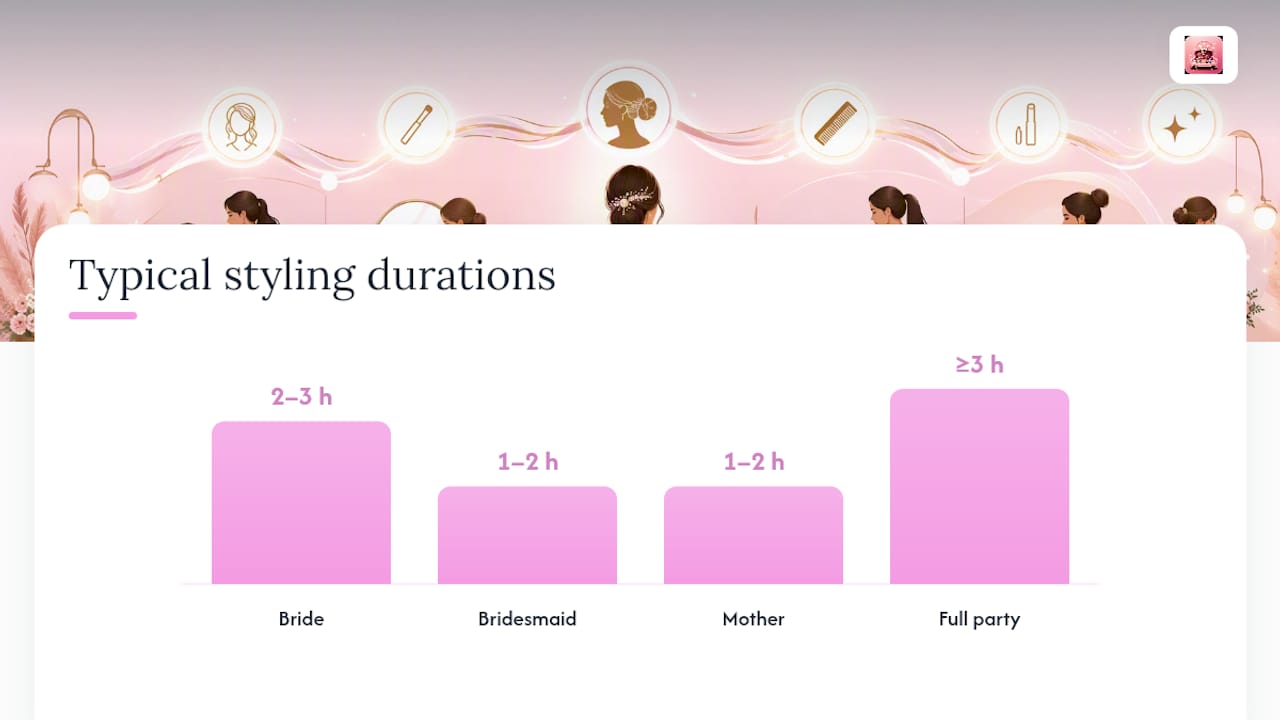
Here's what that looks like when you break it down by role:
Those numbers only hold up if you pad them. A 15-minute buffer between slots absorbs the small delays that happen every single wedding morning: a bobby pin that won't cooperate, a bridesmaid who needs a bathroom break, a text from the venue. Stack a 20 to 30 minute final buffer on top of the last appointment before anyone touches a dress or a photographer picks up a camera.
Here's the math for a 4:00 PM ceremony. Work backward from a "ready by" time of 1:30 PM, which gives you 30 minutes for photos before you have to leave.
- Bride's makeup and hair finish: 1:30 PM
- Bride's chair time (2.5 hours average): starts at 11:00 AM
- Bridesmaid before her finishes: 10:45 AM (with a 15-minute buffer)
- If two artists are working and four bridesmaids need styling before the bride, the first bridesmaid needs to sit down around 7:00 AM
That early start is exactly why most brides underestimate the morning. It doesn't feel like a 4:00 PM wedding requires a 7:00 AM alarm, but the hour-by-hour math says otherwise once you count every head in the room.
How Do You Build Your Own Timeline?
You need three numbers before you write a single time slot: how many people need styling, how long each of them takes, and how many artists you're hiring. Everything else is subtraction.
- List everyone getting hair and/or makeup done, and note whether each person needs both services or just one.
- Assign a realistic duration per person. Use 45 to 90 minutes for hair and 45 to 75 minutes for makeup, with the bride at the higher end of both ranges.
- Add up total chair-hours. Sum every person's combined hair and makeup time.
- Divide by the number of artists you've booked. Two people working simultaneously cut your total time roughly in half; three or four artists compress it further.
- Subtract that number from the time you need to be fully ready. That's your earliest start time.
- Add a 15-minute cushion per person to the total before you subtract, so small delays don't eat into your buffer.
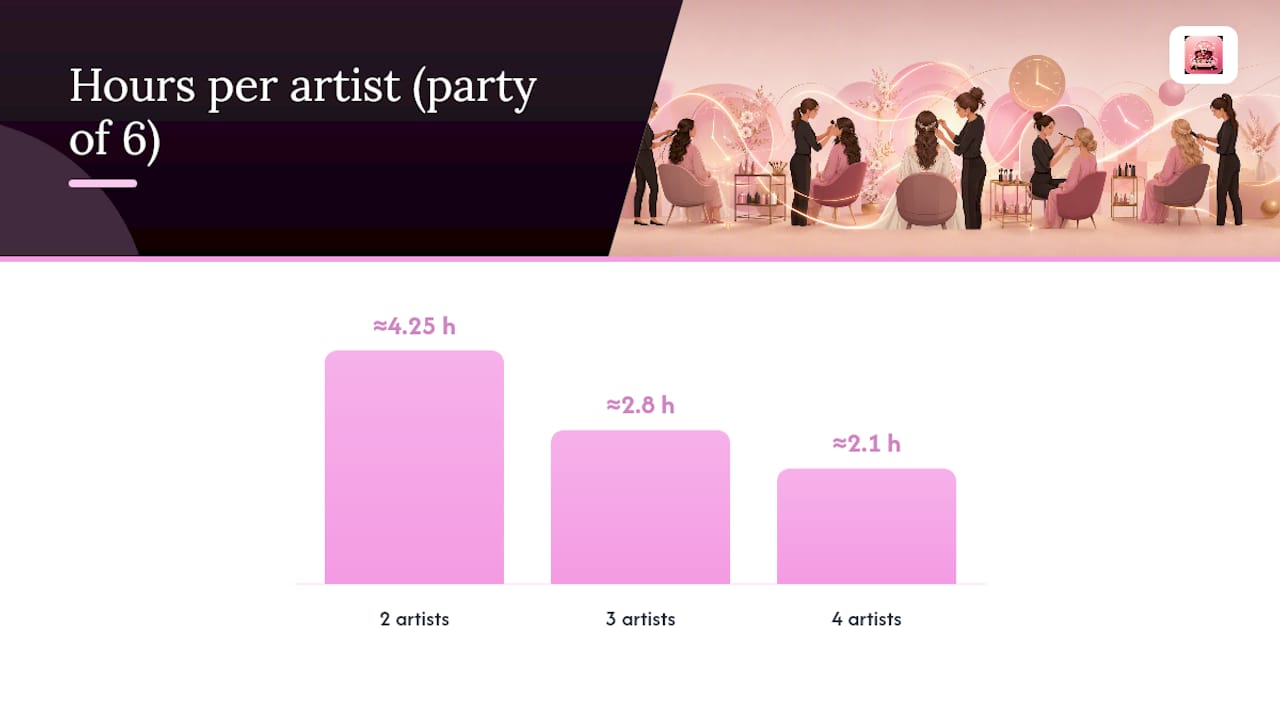
Here's how that plays out for a party of six (bride plus five others) needing a "ready by" time of 1:00 PM:
- Two artists: roughly 8.5 total chair-hours ÷ 2 = 4.25 hours, plus cushions. Start time: around 8:00 AM.
- Three artists: same 8.5 hours ÷ 3 = about 2.8 hours, plus cushions. Start time: closer to 9:30 AM.
- Four artists: 8.5 hours ÷ 4 = roughly 2.1 hours, plus cushions. Start time: near 10:15 AM.
The pattern is clear: every artist you add buys back sleep. Most morning-of failures come down to underestimating time or under-hiring stylists for the size of the party, and paying for one more professional is almost always cheaper than a 5:30 AM wake-up call for eight people.
Pro Tip: If your math pushes the start time before sunrise, that's your sign to hire another artist rather than ask your bridesmaids to set alarms in the dark.
What Order Should Hair and Makeup Happen In?
Hair goes first, makeup goes last, and the bride sits toward the end of the lineup. That sequence isn't arbitrary. It's built around how the tools and products actually behave.
- Hair before makeup because curling irons, hairspray, and heat tools can smudge a finished face; makeup holds up fine under a hair dryer, but foundation doesn't survive a flat iron mishap.
- The bride scheduled second-to-last or last because her look needs to be freshest for the ceremony and portraits, not for a photo taken hours before she walks down the aisle.
- First-look photos are the exception. If you're doing a first look, the bride may need to finish earlier, which means starting her chair time sooner in the overall lineup.
- Longer or thicker hair goes earlier in the day, since intricate braids or extensions take meaningfully more time than a simple blowout.
- Flower girls and kids fit in short gaps between adult appointments, since their sessions run 25 to 35 minutes.
- Give your artists and photographer a one-line script: "Hair first for everyone, makeup last, bride finishes at 1:30, photographer arrives at 12:45 for detail shots." That single sentence prevents more confusion than any spreadsheet.
When Should You Book and Schedule a Trial?
Book your hair and makeup team nine to twelve months before the wedding, especially if your date falls between May and October when demand peaks. If you're inside six months, start reaching out today rather than waiting for the "right" moment in your planning checklist.
- Book 9 to 12 months out for peak season; even off-season dates fill faster than you'd expect once local reviews start piling up.
- Schedule your trial 4 to 6 weeks before the wedding, which leaves enough runway to adjust the look without leaving it to the last minute.
- Use the trial for more than the look. It's your chance to test allergies against new products and confirm exactly how long your style takes to execute.
- Get artist count, arrival time, and setup logistics in writing before the trial ends.
Pro Tip: Trials give you real run-time data, not guesses. Time your own trial with a phone timer and plug that exact number into your timeline math instead of relying on the averages above.
What Should Your Day-Of Checklist Include?
Your artists need a workable space before they can work fast. Confirm bright, even lighting, a chair at counter height, and outlets within reach of every station the morning of the wedding.
- Confirm lighting, chairs, and outlet access the night before, not the morning of.
- Stock water, easy snacks, and a phone charging station so nobody stalls the schedule hunting for an outlet.
- Pack an emergency kit: bobby pins, safety pins, blotting sheets, and a stain remover pen.
- Decide who has authority to simplify a look if the timeline slips, and tell that person in advance.
- Loop in your photographer or planner the moment you sense a delay, not after it's already cost you thirty minutes.
Pro Tip: If the Wedding Hair and Makeup: Complete Guide for Brides (2026) approach to contingencies has one lesson worth memorizing, it's this: converting an intricate updo into a polished blowout can save roughly 20 minutes without making anyone look underdressed. Pick your backup style before the morning starts, not during it.
What Has VÉLOURA Learned From Booking Wedding Mornings?
Mobile professionals cut out the two biggest time-wasters in a traditional salon morning: the commute and the wait. When your stylist and makeup artist arrive at your hotel room or home already set up, that saved travel time often shortens the whole schedule by 30 to 45 minutes across a party of five or six.
Hotel bookings need one extra step home bookings don't: confirming outlet access and elevator logistics with the front desk in advance, so your artists aren't waiting in a lobby while your buffer disappears. Some mobile beauty services connect couples with licensed, vetted beauty professionals for hair, makeup, and nail services delivered wherever the party is getting ready, which means one point of contact instead of three separate vendor conversations to coordinate.
What Does a Well-Run Wedding Morning Feel Like?
The mornings that go smoothly all share one thing: nobody is improvising. Every buffer was built in on purpose, every backup style was chosen ahead of time, and the person in charge of decisions had already made the hard calls before anyone needed to ask. The mornings that go sideways are the ones where a beautiful plan met zero cushion. Your return on ten extra minutes of planning is calm, not chaos.
— VÉLOURA Beauty On Demand
Simplify Your Wedding Morning With VÉLOURA
Coordinating separate hair, makeup, and nail vendors means juggling separate arrival times, separate price quotes, and separate timeline math for each one. VÉLOURA replaces that juggling act with one booking: mobile artists who bring the salon experience to your hotel room or home, scheduled together so your bridal party's chair-hours actually line up the way you planned them on paper.

Some bridal and wedding professionals handle hair styling, makeup artistry, and nail services for parties of any size, with multiple artists available so a large bridal party doesn't force a very early wake-up call. If braided or textured styles are part of your look, plan extra chair time. Reference guides like this detailed breakdown of braid timing when you're building your own math for those services. For skin prep before your trial, a dermatology-backed pre-wedding routine helps your makeup wear better on the day itself.
Visit VÉLOURA's wedding services page to see available artists in your area and request a quote for your bridal party's exact headcount.
Sources
- Wedding Hair and Makeup: Complete Guide for Brides (2026) - Joy
- How Long Does Hair and Makeup for a Wedding? Timeline Template
- Wedding Getting Ready Timeline: Hour-by-Hour Schedule for the Morning of Your Wedding
FAQ
What Is the 30/5 Rule for Weddings?
The 30/5 rule suggests planning for guests to arrive 30 minutes before the ceremony and allowing 5 minutes of buffer for the ceremony itself to start slightly late, though many planners apply similar logic to beauty schedules by building in comparable cushions between appointments.
How Long Does It Take to Get Hair and Makeup Done for a Wedding?
The bride typically needs two to three hours for hair and makeup combined, while bridesmaids and mothers usually take one to two hours each, plus 15-minute buffers between every appointment.
What Is the 2/3 Rule for Makeup?
Definitions of this rule vary across sources; there's no single standard version tied specifically to wedding beauty timing, so it's best not to rely on it when building your schedule.
Is $300 Per Person for Bridal Makeup Average?
Pricing varies widely by region, artist experience, and whether travel is included, so there's no single "average" figure that holds true everywhere. Current pricing for VÉLOURA's mobile makeup services is available directly on the makeup services page.