The future of beauty marketplaces is platformized, wellness-aware, and built around the provider, not just the app. The winners will pair portfolio-first discovery with fair provider economics and AI-led matching, converting more bookings and keeping clients coming back. Founders should treat supply stability and transparent provider pay as the first two problems to solve. Everything else, including growth tactics, follows from getting those right.
TL;DR:
- Success depends on visual, occasion-driven discovery features like portfolio browsing and filters, rather than simple directory listings.
- Providers' earnings improve significantly when platforms offer tools like booking management, CRM, and support for travel logistics, not just access to clients.
- AI-led matching, routing, and dynamic pricing are key technologies that increase booking conversions and reduce costs related to driving and no-shows.
- Building supply stability through targeted recruitment is more critical initially than marketing or extensive app features, especially for regional scalability.
Table of Contents
- Trends in Beauty E-Commerce: How Big Is This Market Getting?
- What Do the Best Beauty Marketplaces Get Right?
- Why Do Some Providers Earn More Than Others on the Same Platform?
- How Is AI Changing Beauty Marketplace Technology?
- What Business Models Actually Work for Beauty Marketplaces?
- What Trust and Safety Standards Should Clients Expect?
- How Do You Build and Scale a Beauty Marketplace?
- Who's Actually Competing in the Beauty Marketplace Space?
- What Regulations Apply to Mobile and In-Home Beauty Services?
- Where Do Partnerships Fit in a Marketplace Strategy?
- What Actually Keeps Clients Coming Back?
- Does Sustainability Matter to Beauty Marketplace Clients?
- VÉLOURA's View: What Building This Platform Actually Taught Us
- Book Beauty on Your Terms with VÉLOURA Beauty On Demand
- Sources
- FAQ
Trends in Beauty E-Commerce: How Big Is This Market Getting?
The mobile beauty on-demand category is no longer a niche experiment. Reed Intelligence projects the U.S.
Market snapshot: U.S. mobile beauty platforms are on pace to more than triple over the next decade, from $660.74 million to $2.21 billion, growing more than four times faster than most mature retail categories.
Hair services still make up the largest slice of bookings today, but nail care is the fastest-growing segment, driven by short appointment cycles and easy repeat scheduling. Occasion-based demand, weddings, corporate events, and group bookings are where the real margin sits, since one booking can turn into six or eight billable appointments.
The behavioral signals back this up. Salonist's Beauty Trends Report found that a meaningful share of bookings now happen after standard salon hours, and mobile-first booking flows measurably improve retention among first-time online clients. That's not a convenience story. It's a distribution shift: the client who books at 9 p.m. from her couch isn't calling a salon back the next morning. Analysts at EY frame this as a broader convergence of beauty and wellness, where appearance care is treated as one input into overall health, not a separate errand.
What Do the Best Beauty Marketplaces Get Right?
Winning platforms treat discovery as a visual, occasion-driven decision, not a directory search. A bride doesn't want to scroll a list of names. She wants to filter by "bridal," see portfolio photos of actual finished looks, and book a trial session before committing to the wedding day team.
The product priorities that separate a marketplace from a glorified contact list:
- Portfolio-first browsing where photos and past work lead, and bios are secondary.
- Occasion filters (bridal, corporate, in-room hotel) that shortcut the search for high-intent bookings.
- Group and trial booking flows built for parties of five or more, not retrofitted from single-appointment logic.
- Deposits and calendar sync that cut down on last-minute cancellations and no-shows.
- Clear cancellation rules stated up front, not buried in a terms page nobody reads.
Routing and travel fee design deserve their own line item. Industry pricing analysis shows mobile beauty can command salon-comparable pricing while cutting a provider's fixed overhead, but only if travel fees are structured fairly and routing keeps drive time from eating the day.
Pro Tip: Build occasion filters before you build a loyalty program. A bride books once but refers ten more brides; a loyalty point system won't do that work for you.
Why Do Some Providers Earn More Than Others on the Same Platform?
Joining a marketplace doesn't automatically raise a provider's income, and pretending otherwise sets founders up for churn they didn't see coming. A peer-reviewed study in the Journal of Management Studies, covering 1,856 providers and 435,867 transactions, found that platforms expand a provider's reach, but participating providers can end up with lower sales than non-participants unless they also adopt the platform's complementary services. Providers who used tools like booking management, CRM features, and inventory tracking saw measurably higher performance and stronger reputation gains.
That finding should reshape how operators think about retention:
- Predictable take-home pay (a higher percentage of the booking, or flat fees) beats a low headline commission with hidden deductions.
- Complementary tools, not just booking access, are what actually move a provider's earnings.
- Travel logistics support, equipment provisioning, and insurance coverage all reduce the hidden costs providers absorb quietly until they quit.
- Optional paid visibility features let providers choose their own tradeoff instead of getting pushed into a one-size commission structure.
Reach without revenue is a churn machine. Reach paired with the right tools is a career.
How Is AI Changing Beauty Marketplace Technology?
AI matching is the difference between a client scrolling for ten minutes and a client booking in ten seconds. Matching engines that weigh style preference, past bookings, and real-time availability convert better and drive more repeat visits than static search filters ever did.
Three technical investments carry outsized returns:
- AI-led matching that pairs clients with providers based on style history and proximity, not just star rating.
- Routing and cluster scheduling that group nearby appointments so providers spend more time working and less time driving.
- Dynamic pricing for peak windows and group bookings, a practice detailed in Searchoneers' pricing guide, paired with calendar and payment integrations that cut no-shows before they happen.
The math that matters: every minute a provider spends driving instead of working is a minute the platform doesn't earn commission on. Routing isn't a nice feature. It's a margin lever.
What Business Models Actually Work for Beauty Marketplaces?
A pure commission model is simple to explain but fragile to run. Charge too much and providers defect to direct booking; charge too little and the platform can't fund support, insurance, or growth. Most durable marketplaces blend revenue streams instead of betting everything on one.
- Commission on bookings remains the core engine, but it works best around 20% or lower, leaving providers a majority take-home.
- Subscriptions or memberships for frequent clients create predictable recurring revenue and reduce marketing spend per booking.
- B2B and event revenue, corporate wellness days, hotel partnerships, wedding parties, carries meaningfully higher order values than single appointments.
- Ancillary revenue, gift cards, product sales, premium travel fees, adds margin without touching the core commission rate.
The platforms treating booking fees as their only lever are leaving the highest-margin revenue on the table.
What Trust and Safety Standards Should Clients Expect?
In-home and hotel-room services carry a different risk profile than a walk-in salon visit, and the trust bar has to reflect that.
- License and background verification for every provider before their first booking, with documentation checked and refreshed, not verified once and forgotten.
- Insurance confirmation covering liability for services performed on-location, disclosed clearly rather than buried in fine print.
- Verified portfolios and moderated reviews that prevent fake work samples or manipulated ratings from misleading clients.
- A clear incident and dispute process, published where clients can find it before they need it, not after something goes wrong.
Skipping any one of these isn't a shortcut. It's a liability with a delayed timer.
How Do You Build and Scale a Beauty Marketplace?
Marketplaces die from cold starts, not bad ideas. Solve the supply side first, or the demand side never gets a reason to stay.
- Recruit supply before demand. Sign 30 to 60 proven providers focused on one high-value occasion, bridal, corporate, or hotel partnerships, before spending a dollar on client acquisition.
- Ship a lean MVP. Portfolio galleries, booking with deposits, calendar sync, travel radius settings, and basic routing cover the essentials; skip anything more until usage proves it's needed.
- Track the five KPIs that predict survival: booking conversion rate, repeat booking rate, provider churn, average travel distance, and gross margin per booking.
- Build the onboarding playbook early. Clear compensation terms and early-adopter incentives keep your first cohort of providers from walking when a competitor calls.
Pro Tip: Onboarding tools that match a provider's existing workflow, lightweight scheduling, predictable pricing, keep churn lower than any bonus program. Providers don't leave for a better app. They leave for a simpler one.
Who's Actually Competing in the Beauty Marketplace Space?
The competitive landscape splits into three camps: legacy salon booking software bolted onto a marketplace layer, venture-backed on-demand apps chasing single-city density, and vertical specialists focused on one occasion type like bridal or corporate wellness. None of these approaches wins on price alone, because price competition in a two-sided marketplace erodes provider margins faster than it grows client volume.
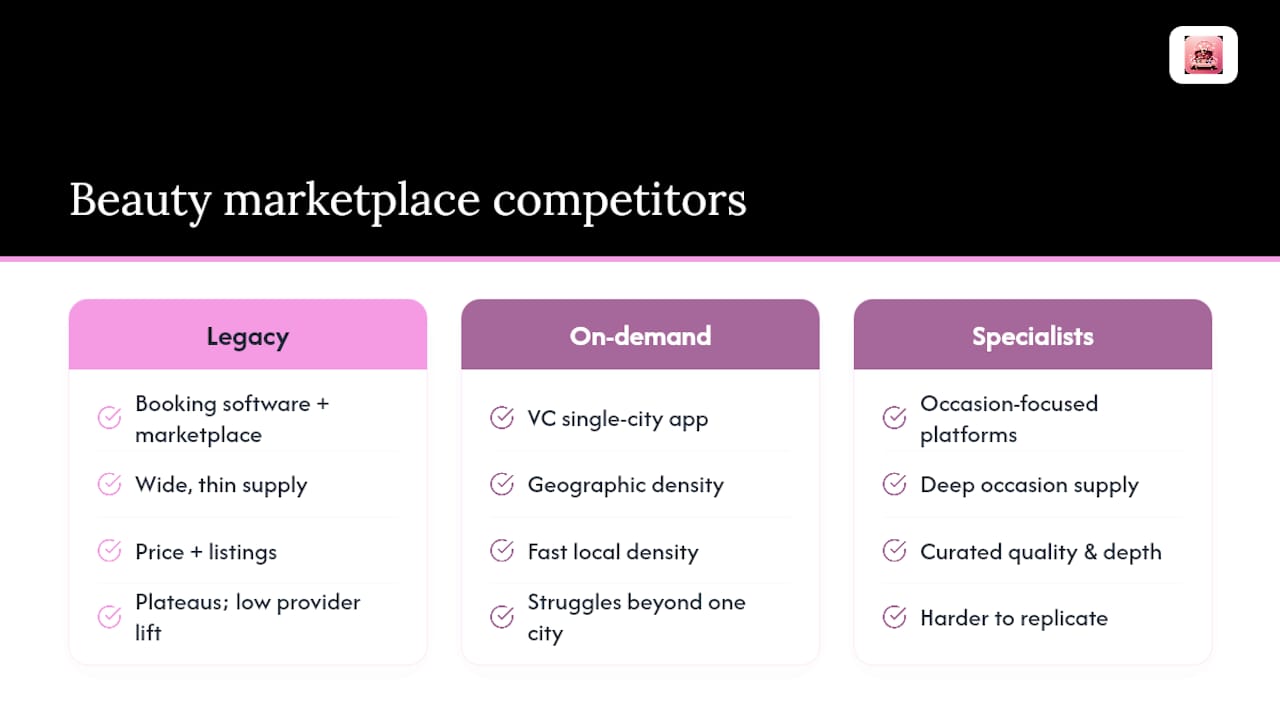
Differentiation increasingly comes from three places: curated supply quality, occasion depth, and how well the platform serves adjacent markets like senior care or corporate wellness that generic booking apps ignore entirely. A platform that can credibly serve a bride, a hotel guest, and a homebound senior under one operational model has a moat that a single-purpose booking app can't easily replicate. Geographic density matters too. A marketplace with thin supply spread across ten cities loses to one with deep, reliable coverage in three.
The platforms likely to struggle are the ones still treating this as a directory business, list providers, take a cut, hope for repeat visits. That model plateaus fast because it does nothing to improve provider outcomes or deepen the client relationship beyond a single transaction. The ones built to last are investing in what happens after the first booking: whether the provider stays, whether the client rebooks, and whether the platform can serve that same client differently five years from now as her needs change.
What Regulations Apply to Mobile and In-Home Beauty Services?
Mobile beauty operates at the intersection of cosmetology licensing law, which varies by state, and general marketplace liability rules that were mostly written before location-flexible service delivery existed. Every state requires cosmetology, esthetics, or nail technician licensing, but requirements for providing services outside a licensed salon location vary, and some states have specific mobile-service permitting that platforms must track provider-by-provider.
Insurance is the second compliance layer, and it's more complicated than a standard salon policy. Liability coverage needs to account for services performed in a client's home, a hotel room, or an office, environments the platform doesn't control the way a salon owner controls their own space. Sanitation and equipment standards still apply even without a fixed location, which means providers need documented protocols for tools and product handling that a mobile setting doesn't automatically enforce.
Worker classification is the compliance question that carries the most financial risk. Whether providers are treated as independent contractors or employees affects tax withholding, benefits obligations, and labor law exposure, and the answer isn't uniform across every state a platform operates in. Getting this wrong doesn't surface immediately. It surfaces during an audit or a lawsuit, often years after the classification decision was made. Any platform operating across multiple states needs counsel reviewing this on a rolling basis, not a one-time setup checklist.
Where Do Partnerships Fit in a Marketplace Strategy?
Salons, product brands, and hospitality companies aren't threats to a mobile beauty marketplace. They're distribution channels a platform can't build on its own. A salon that's fully booked on weekends can refer overflow clients to a mobile platform without losing the relationship, while product brands get access to a direct-to-client channel through providers who are already recommending and applying their products in real time.
Hotel partnerships deserve particular attention because they solve two problems simultaneously: guest demand for in-room services and the hotel's interest in offering a premium amenity without hiring in-house staff. This is a genuinely productized relationship, not a favor between businesses, and it tends to produce steady, recurring booking volume once established.
Wellness brands are the newer, faster-growing partnership category. As EY's analysis of beauty and health investment points out, consumers increasingly treat beauty and wellness as one continuous need rather than separate purchases. A platform that can route a client from a facial to a wellness check-in, without asking her to open a second app, is positioned to capture more of her spending, not just more of her time. Programs like PRYM's wellness offerings illustrate how preventative and wellness services can sit alongside beauty in a single client relationship. Partnerships built around this convergence tend to outperform partnerships built purely around cross-promotion or discount codes.
What Actually Keeps Clients Coming Back?
Acquisition in beauty marketplaces is expensive if every client is treated as a one-time booking to win. The platforms with the best economics acquire a client once and then earn four, six, or ten bookings from her over the following year, and that only happens when the first experience is good enough to make rebooking feel obvious.
Referral behavior is the cheapest acquisition channel in this category, and it's underused. A bride who books her wedding party through a platform doesn't just rebook herself, she puts the brand in front of six or eight bridesmaids who each have their own future events. Occasion-based bookings aren't just higher-margin transactions; they're built-in referral engines that most platforms fail to design around intentionally.
Retention comes down to three mechanics: making rebooking effortless (saved preferences, one-tap repeat bookings), matching clients with the same provider whenever possible so the relationship compounds, and communicating proactively around events clients have already flagged, birthdays, anniversaries, seasonal touch-ups. The Salonist trends data on after-hours mobile bookings suggests convenience alone drives a meaningful share of retention, but convenience without a personal thread, the same stylist, the same preferences remembered, caps out fast. Clients don't stay loyal to an app. They stay loyal to how a service made them feel, and then the app becomes the easiest way to get that feeling again.
Does Sustainability Matter to Beauty Marketplace Clients?
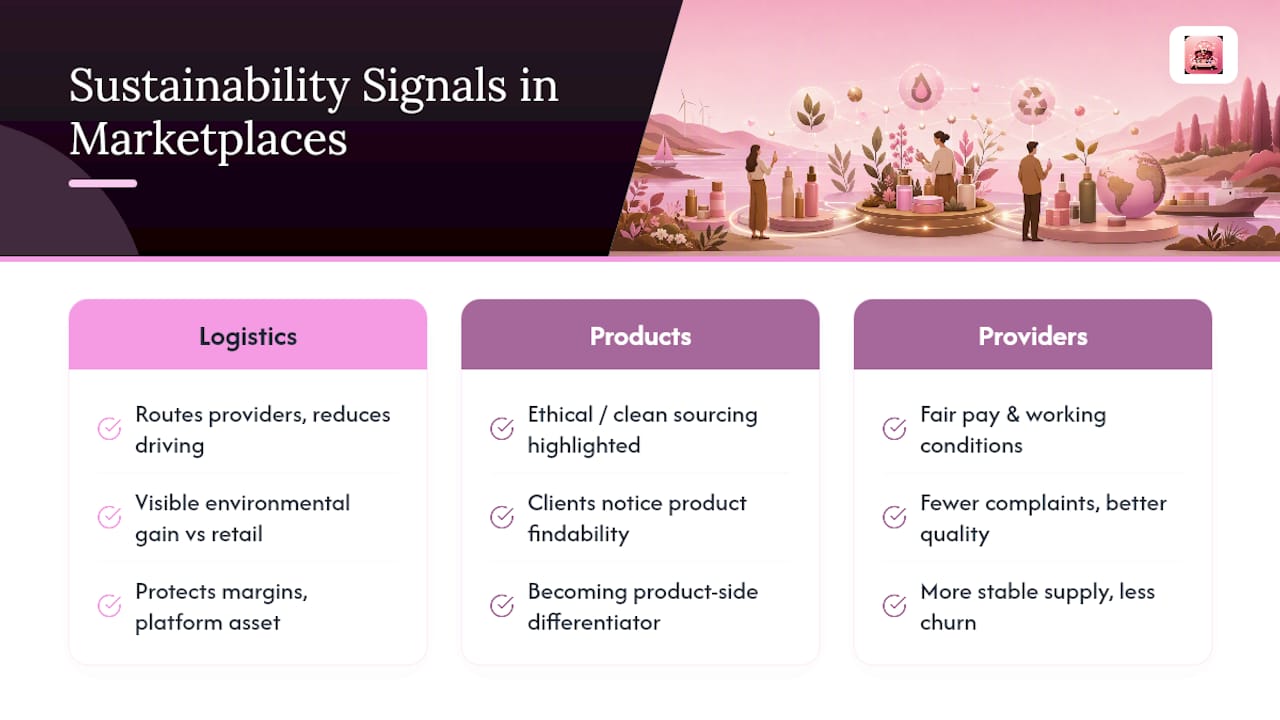
Sustainability in mobile beauty isn't primarily about packaging, it's about logistics. A platform that routes providers efficiently isn't just protecting margins; it's cutting the driving miles that come with a business model built entirely on travel. That's a genuine environmental difference between mobile beauty and traditional retail, and it's one most platforms haven't figured out how to talk about yet.
Ethical sourcing is becoming a real differentiator on the product side, as providers increasingly carry and recommend clean or sustainably sourced product lines, and clients notice which platforms make that easy to find versus which ones treat it as irrelevant. Provider treatment is the other half of the ethics conversation, and it's the one investors should scrutinize hardest. A marketplace that quietly depends on underpaying providers to keep commission structures attractive to investors isn't building a sustainable business model, it's building a churn problem that eventually shows up in supply shortages, uneven quality, and client complaints that trace back to overworked or underpaid talent.
The platforms treating provider welfare as core to the business, not as an afterthought to publicity, tend to have more stable supply and fewer quality complaints over time. That's not a coincidence. It's the same logic driving the reach-versus-revenue findings from the Journal of Management Studies research: a marketplace that only optimizes for its own take rate, without investing in the providers doing the work, eventually pays for it in supply quality.
VÉLOURA's View: What Building This Platform Actually Taught Us
VÉLOURA Beauty On Demand grew city by city on purpose, Los Angeles first, then New York, then Miami, because supply quality doesn't scale the way demand does. Each market needed its own vetted bench of providers before we opened bookings, not the other way around. That sequencing is slower than a national launch, but it's the reason we could serve busy professionals, brides, hotel guests, and seniors from day one in each city without diluting quality.
VÉLOURA Care, our senior wellness offering, grew out of client feedback we didn't expect, proof that the convergence of beauty and wellness isn't a trend slide in a strategy deck. It's what clients were already asking for.
— VÉLOURA Beauty On Demand
Book Beauty on Your Terms with VÉLOURA Beauty On Demand
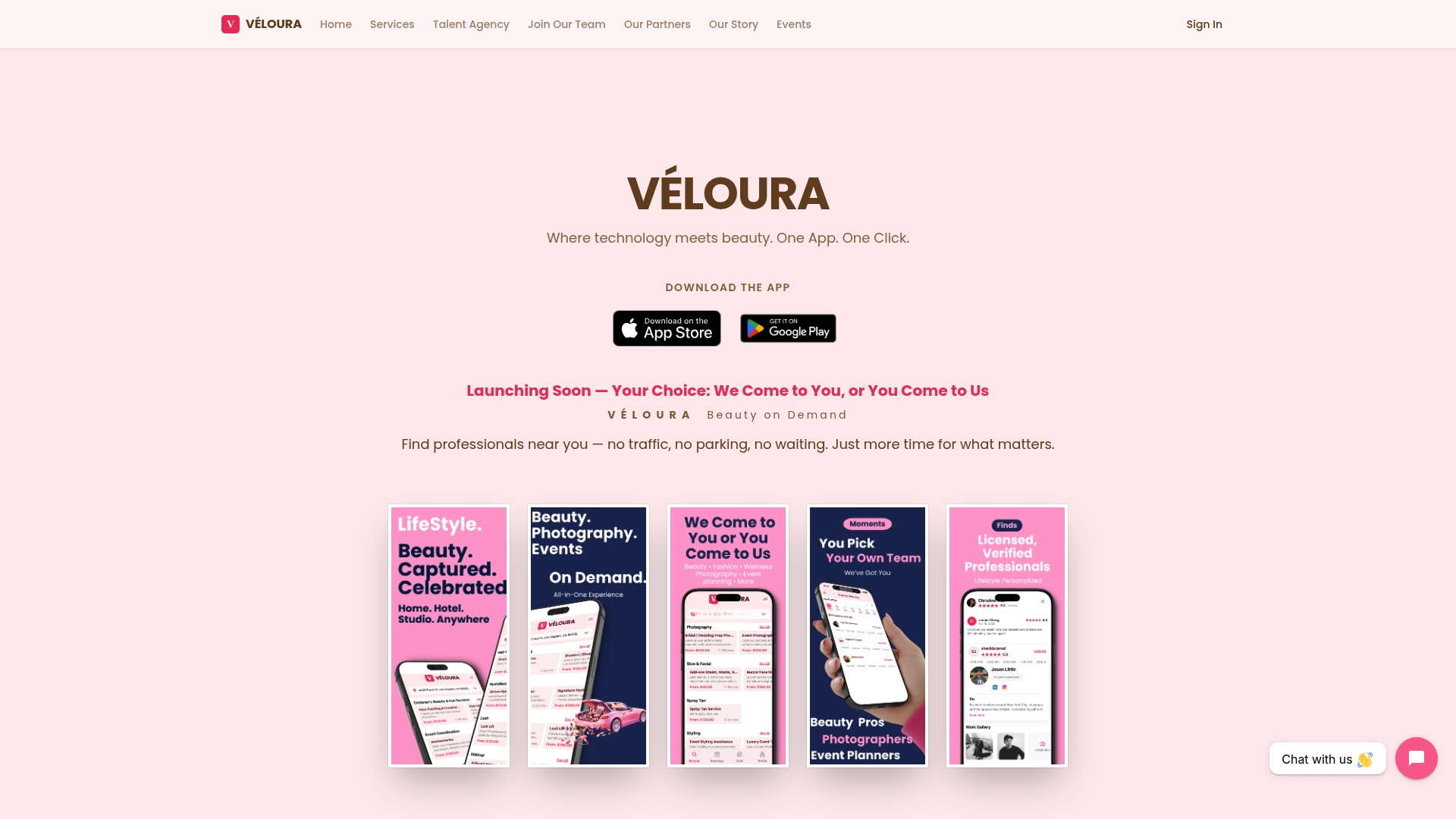
Whether you're a bride assembling a wedding-day team, a hotel guest who wants a blowout before dinner, or a professional who hasn't had time for a manicure in months, the booking flow works the same way: browse real portfolios, pick your occasion, and confirm a time that fits your schedule instead of a salon's.
Ready to see it in action? Check out mobile hair styling and makeup services, browse wedding beauty packages, or find VÉLOURA in Los Angeles, New York, or Miami. Book your first appointment today and see what beauty on your schedule actually feels like.
Sources
- United States Mobile beauty on demand platform market Size, Share & Growth Report By 2034
- 2026 beauty and health investment and strategy insights — EY
- Digital platforms and service provider outcomes — Journal of Management Studies (Wiley)
FAQ
What Is a Beauty Marketplace?
A beauty marketplace is a platform that matches clients with licensed, vetted beauty professionals for on-location services, delivered at home, in a hotel, or at an office, rather than requiring a salon visit.
How Big Is the Mobile Beauty Marketplace Market?
The U.S. mobile beauty on-demand platform market is valued at $660.74 million in 2025 and is projected to reach $2,210.31 million by 2034, a 14.42% compound annual growth rate.
Do Beauty Professionals Earn More on Marketplaces?
Not automatically. Research shows providers gain reach on marketplaces but can end up with lower sales than non-participants unless they also adopt complementary platform services such as booking management and CRM features, which correlate with higher earnings.
What Should Founders Prioritize First When Building a Beauty Marketplace?
Supply stability comes first: recruiting a curated group of 30 to 60 reliable providers around one high-value occasion before investing heavily in client acquisition or app features.