Yes, mobile beauty professionals need business insurance, and it is not optional if you want to keep working after your first claim. Prioritize three things: public liability, professional (treatment) liability, and coverage for your kit while it travels with you, exploring options like the Best Business Health Insurance Plans for Small Businesses in Florida. Your homeowners or personal auto policy almost certainly will not step in when something goes wrong on the job. Before you request quotes, write down every service you offer, your kit's replacement value, and how often you drive to appointments.
TL;DR:
- A mobile beauty professional's insurance should include public liability, professional liability, and tools coverage, especially for gear stored in vehicles or on-site.
- Insurance costs range from $300 to $700 per year, influenced by services offered, equipment value, claim history, and location, with higher risks requiring higher limits.
- Properly listing all treatments and declaring kit values prevent claim denials, while comparison of policies must focus on coverage specifics, exclusions, and claims service quality.
- Homeowners and personal auto policies generally do not cover business activities, making dedicated business or commercial auto policies essential for claims and liability protection.
- Providing proof of insurance and licensing when booking through platforms or venues is crucial for securing clients and avoiding legal or coverage gaps.
Table of Contents
- What Does Mobile Beauty Insurance Actually Cover?
- How Much Does Mobile Beauty Insurance Cost?
- How Do You Choose the Right Policy for Mobile Work?
- What Happens When You File a Claim?
- Where Mobile Work Falls Through the Cracks
- Where Can You Get a Quote Fast?
- The Mistake That Costs Mobile Pros the Most
- What Are the Legal Requirements for Mobile Beauticians?
- Does Hairdressing Need Different Coverage Than Massage Therapy?
- What Risk Management Steps Reduce Your Chances of a Claim?
- Does Your Location Affect Your Insurance Options?
- Why VÉLOURA Requires Proof of Insurance
- Ready to Put That Coverage to Work?
- Sources
- FAQ
What Does Mobile Beauty Insurance Actually Cover?
Mobile beauty insurance is not one product. It is a bundle of coverages built for people who work out of a bag, a car, and other people's living rooms instead of a fixed salon chair. Understanding what each piece protects is the difference between buying real coverage and buying a false sense of security.
Public liability covers the basics of doing business around other people. If a client trips over your styling case, or you knock over a lamp and damage a hotel room's carpet, this is what pays. Insurance carriers that write policies for personal-care businesses typically build in per-occurrence limits, and general liability coverage for personal-care businesses is treated as a baseline requirement, not an upgrade.
Professional liability, sometimes called errors and omissions, is the coverage mobile pros underestimate most. It responds when the claim is about the work itself, not a slip-and-fall. A botched keratin treatment that burns a client's scalp, a lash adhesive reaction, or a nail infection traced back to your tools all fall here. Public liability will not touch these. You need both.
Tools and contents coverage protects the equipment that makes you money: clippers, curling irons, nail lamps, lash kits, your entire rolling case. This matters more for mobile pros than salon-based ones, because your gear spends hours in a car trunk or a client's foyer instead of a locked storefront.
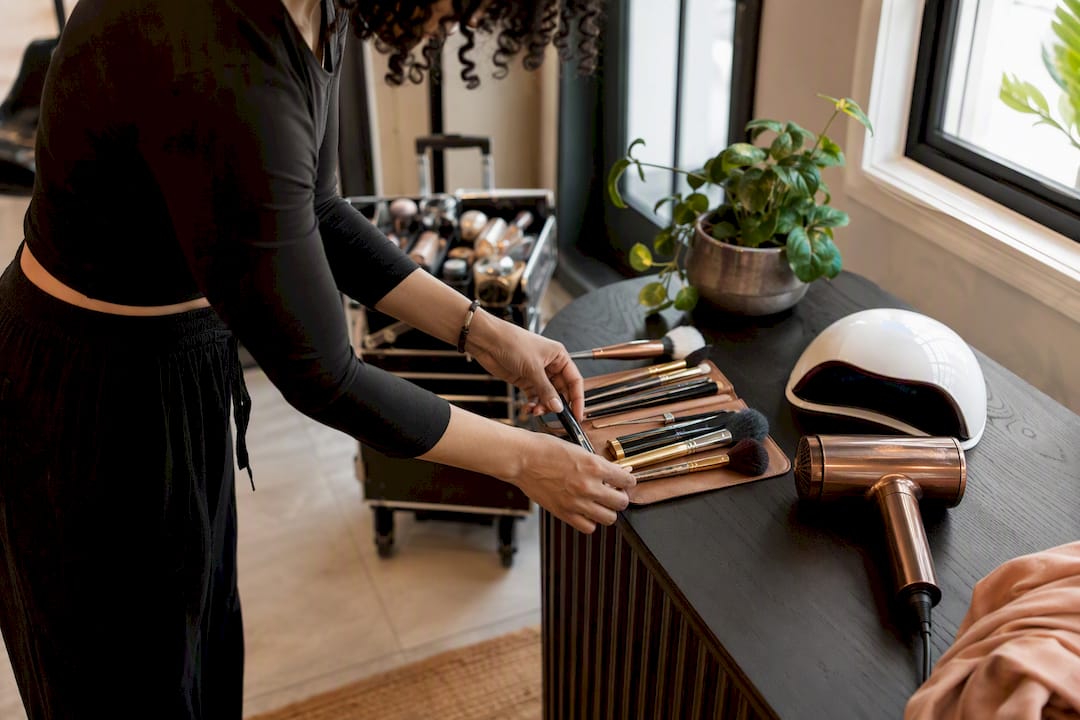
Then there is the vehicle question. If you are driving a car full of $3,000 in styling tools to three appointments a day, that is business use, and personal auto policies frequently deny claims tied to business-related driving. A commercial auto policy or a business-use endorsement closes that gap.
Depending on your services, consider these add-ons too:
- Product liability if you sell or apply retail products
- Communicable disease coverage, increasingly common since 2020
- Assault and battery coverage for close-contact services
- Business interruption to cover lost income if you cannot work after an incident
Many nail and beauty pros pay roughly $300 to $500 per year for comprehensive coverage, though your final number depends on which of these pieces you stack together.
How Much Does Mobile Beauty Insurance Cost?
Budget somewhere between $300 and $700 a year for a solo mobile beauty professional carrying public liability and professional liability together, based on typical ranges reported by specialist providers. That works out to a moderate monthly amount, which is less than most pros spend on product restocking in a slow week.
Several factors push that number up or down:
- Services offered. Basic manicures cost less to insure than chemical hair treatments or lash extensions with adhesive exposure.
- Policy limits. A $1 million per-occurrence limit costs more than a $500,000 limit, but it is what most venues and corporate clients require anyway.
- Declared kit value. Higher-value equipment (professional dryers, LED lamps, microdermabrasion tools) raises your contents premium.
- Claims history. A clean record keeps renewal pricing stable; even one prior claim can bump your rate noticeably.
- Geography and revenue. Urban markets with higher living costs and higher claim frequency tend to run pricier than rural areas.
A basic public-liability-only policy sits at the low end of that range. A full package with professional liability, contents coverage, and a commercial auto endorsement lands closer to the top. If you want to trim costs without cutting coverage, bundle your policies with one carrier, list your services accurately from the start, and consider a higher deductible if you have savings to absorb a small claim yourself.
Pro Tip: Ask your insurer whether bundling public liability and professional liability into one package policy is cheaper than buying them separately. It usually is, sometimes by a meaningful margin.
How Do You Choose the Right Policy for Mobile Work?
Comparing quotes side by side only works if you are comparing the same coverage. A cheap policy that excludes your actual services is not a deal, it is a gap waiting to open. Use this sequence when you evaluate offers.
- Match services to the policy wording. List every treatment you perform, from basic blowouts to keratin smoothing, and confirm each one appears on the insurer's covered-services list. Insurers routinely exclude higher-risk treatments unless a client explicitly declares them, so a vague "hair services" line is not good enough.
- Set your minimum limits. Most hotels, event venues, and corporate clients expect at least $1 million in general liability. Confirm the policy covers you "away from premises," since some cheaper plans quietly restrict coverage to a fixed studio address.
- Value your equipment honestly. If you carry a few thousand dollars in tools, make sure the contents limit reflects that, and ask whether high-value electrical items need to be scheduled individually with serial numbers for full replacement.
- Check the exclusions and legal defense limit. Read what is carved out, not just what is promised, and confirm the policy pays legal defense costs separately from the liability limit rather than eating into it.
- Compare claims service, not just price. A slightly higher premium from an insurer known for fast claims handling often beats a cheaper policy with a reputation for delays.
Ask your broker directly whether the policy includes an "additional insured" endorsement, since many hired venues require your certificate to name them specifically before they will let you work on-site.
Walk away from any quote that will not put covered services in writing, that caps vehicle contents at a token amount, or that cannot explain its exclusions in plain language. If an insurer cannot answer a direct question about your specific treatment list, that is a dealbreaker, not a detail to sort out later.
What Happens When You File a Claim?
The moments right after an incident shape whether your claim gets paid quickly or gets stuck in review. Treat every incident, even a minor one, the same way.
- Secure the scene first. Stop the service if needed, and make sure the client is safe before anything else.
- Document everything. Photos of the area, the product used, and any visible reaction or damage matter far more than a written recollection days later.
- Collect witness information. A property owner, a coworker, or another client present at the time can support your account.
- Preserve your kit. If a product or tool is involved, do not discard it. Insurers often want it examined.
Most insurers ask for your service agreement, before-and-after photos if relevant, and a written timeline of what happened. Your deductible applies before the payout starts, and legal defense costs typically run separately from the liability payout itself, which is why that defense limit from the buying checklist matters. Filing promptly and with complete documentation is the single biggest factor in how fast a claim settles, and it protects your renewal pricing down the line.
Where Mobile Work Falls Through the Cracks
Every mobile pro eventually discovers a gap they did not know existed, usually at the worst possible moment. A few show up constantly.
- Homeowners and personal auto policies exclude business activity. These are written for personal risk, and carriers routinely deny claims tied to running a business out of a home or car, even part time.
- Undeclared treatments create silent exclusions. If your policy lists "manicures" but you also do gel extensions, a claim tied to extensions may get denied outright.
- Vehicle contents in transit are often capped low unless you specifically request higher limits or a commercial auto endorsement for business-use driving.
- Hired venues sometimes require you to be named as additional insured, which most standard policies do not include automatically.
The fix in every case is the same: declare fully, ask specifically, and buy the separate policy (commercial auto, product liability endorsement) when your standard package does not stretch far enough.
Where Can You Get a Quote Fast?
You have three practical paths: specialist beauty insurers, online quote portals, and brokers. Specialist insurers understand mobile work already, which speeds things up. Online forms are fastest for straightforward setups. Brokers are useful for complex situations involving multiple services, high-value kit, or frequent event work at hired venues.
- Gather your numbers first: annual revenue, full service list, total kit value, how you use your vehicle for work, and whether you have any employees or subcontractors.
- Build a one-page factsheet with those details so you can send identical information to two or three insurers and compare real apples-to-apples quotes.
- Request same-day proof of insurance when you apply. Many specialist providers now offer instant certificates so you are not stuck waiting to book a venue.
- Call a broker if your setup is complex. Event work, higher limits, or multiple service categories are where a broker's market knowledge saves real money.
The Mistake That Costs Mobile Pros the Most
The single most expensive mistake is assuming a homeowners or personal auto policy has your back. It does not, and specialists in the space repeat this warning constantly because the denial pattern is so consistent.
Pro Tip: List every treatment by name when you apply, and photograph your kit for a valuation record. Under-declared services and under-valued equipment are the two most common reasons claims get reduced or denied.
Picture two scenarios. A client has an allergic reaction to a lash adhesive that was not listed on your policy's service schedule, the claim gets contested. Or your case of tools is stolen from your car between appointments, but your contents limit was set at $500 for a $4,000 kit, you get a fraction of the loss back. Both are avoidable with an accurate application. Platforms that vet licensed mobile beauty pros request proof of insurance for exactly this reason: it protects clients and reduces disputes before they start.
What Are the Legal Requirements for Mobile Beauticians?
Insurance requirements for mobile beauticians depend on your state's cosmetology or esthetics licensing board and, in many cases, on the venues you work with. Most states require an active cosmetology, nail technician, or esthetician license to legally perform services at all, mobile or otherwise, and losing that license because of an uninsured incident is a real risk many pros overlook.
Few states mandate liability insurance outright the way auto insurance is mandated for drivers. But that does not make it optional in practice. Hotels, corporate offices, wedding venues, and increasingly, booking platforms themselves require proof of insurance before they will let you work on their property. A venue's own liability coverage typically will not extend to an independent contractor performing services there, which means you are exposed unless you carry your own policy.
If you operate as an LLC or sole proprietorship, check your state's requirements for workers' compensation too, especially if you ever bring on an assistant or subcontractor, since misclassifying help can trigger both legal and insurance complications. Local health department rules may also require sanitation and licensing documentation on hand during mobile visits, separate from your insurance paperwork entirely. When in doubt, a quick call to your state cosmetology board clears up what is legally mandated versus what is simply smart business practice, and your insurer or broker can usually tell you what documentation your target venues expect to see.
Does Hairdressing Need Different Coverage Than Massage Therapy?
Coverage needs shift significantly based on what you actually do to a client's body, and treating all mobile beauty services as one risk category is a common pricing mistake. A mobile hairstylist doing cuts and color faces different exposures than a mobile esthetician offering massage or advanced skin treatments.
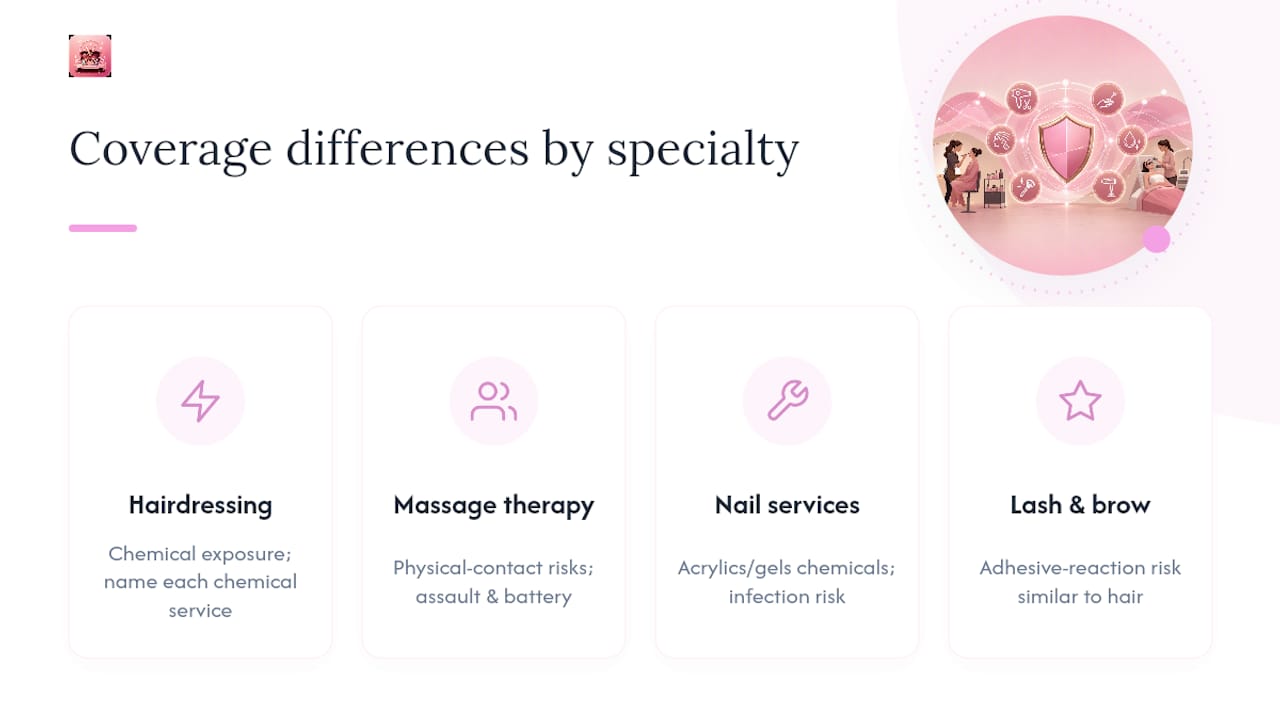
Hairdressing carries chemical exposure risk. Color, bleach, keratin treatments, and relaxers can cause burns, allergic reactions, or hair damage, so professional liability needs to explicitly list every chemical service you perform. A basic "haircut and style" policy will not extend to a chemical straightening treatment gone wrong.
Massage therapy and bodywork carry a different risk profile entirely: physical contact, positioning injuries, and claims related to inappropriate touch allegations. This is where assault and battery coverage becomes far more relevant than it would be for a manicure appointment. Massage therapists also frequently need to show proof of specific massage therapy licensing, which differs from a cosmetology license in most states.
Nail services sit in between, chemical exposure from acrylics and gels, plus infection-related claims if sanitation lapses. Lash and brow services carry adhesive-reaction risk similar to hair chemical claims. The practical takeaway: never assume a generic "beauty professional" policy automatically covers your specific specialty. Confirm your named treatments match your actual client-facing services, treatment by treatment.
What Risk Management Steps Reduce Your Chances of a Claim?
Insurance is your safety net, not your first line of defense. The mobile pros who file the fewest claims share a few habits that cost nothing but attention.
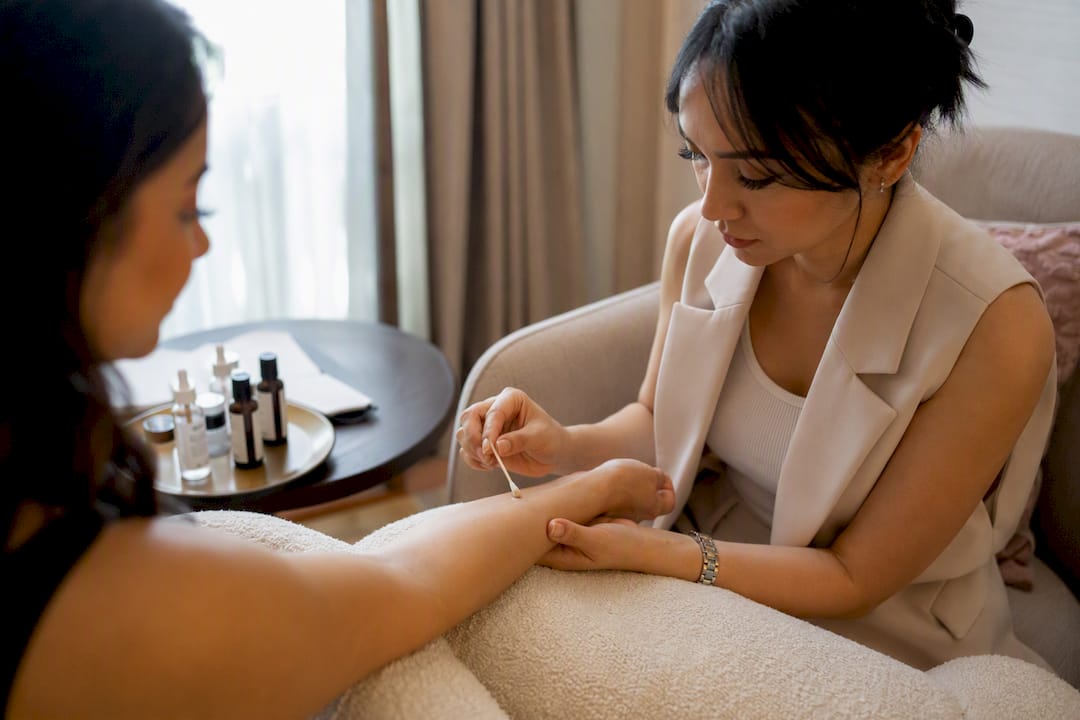
Start with intake forms. A simple client consultation form that asks about allergies, prior reactions, and skin sensitivities before a chemical service catches problems before they happen. Keep signed copies on file, they double as documentation if a dispute arises later.
Patch test before any new chemical service, every time, even for returning clients. Skin sensitivity changes, and a five-minute patch test 24 to 48 hours before a full application is standard practice for a reason.
Maintain your kit properly. Sanitize tools between clients according to your state board's standards, and replace worn equipment (frayed cords, cracked lamps) before it becomes a safety issue rather than after. Secure your equipment in your vehicle with a lockbox or covered storage rather than leaving it visible, since visible kit in a parked car is an easy theft target.
Finally, photograph your workspace setup at each appointment, before and after. It takes thirty seconds and gives you a record if a client later disputes damage to their property that was not your doing.
Does Your Location Affect Your Insurance Options?
Where you work shapes both your premium and which coverages actually matter. Dense urban markets, think Los Angeles, New York, or Miami, tend to carry higher premiums, driven by higher claim frequency, higher venue standards, and higher costs of legal defense if a dispute goes to court. If most of your bookings happen in high-rise apartments, hotels, or corporate offices in a major city, expect venues to ask for higher liability limits than a rural client working out of a private home would ever require.
Rural and suburban mobile pros often see lower base premiums, but should not assume that means lower risk. Longer drives between appointments increase vehicle exposure, and a commercial auto endorsement matters just as much, sometimes more, when you are covering more highway miles per week.
State regulations also vary in how they define professional versus personal auto use, and in whether massage therapists, estheticians, or nail techs need separate state licensing categories. If you work across state lines, for weddings or events, confirm your policy extends coverage nationally rather than being state-locked, since some regional carriers restrict where claims are honored.
Why VÉLOURA Requires Proof of Insurance
We ask every professional on our platform for proof of insurance and an active license, and we do not treat that as a formality. It is how we protect clients booking a stranger into their home, and it is how we keep hotel and corporate venue partners confident enough to keep opening their doors to mobile professionals. When a venue trusts the vetting process, bookings move faster for everyone. Keep your policy documents and certificate of insurance handy when you join platforms or confirm events. It is the fastest way to turn a booking inquiry into a confirmed appointment.
— VÉLOURA Beauty On Demand
Ready to Put That Coverage to Work?
Once your public liability and professional liability are sorted, the next question is where to find clients worth insuring yourself for. VÉLOURA Beauty On Demand connects licensed, background-checked mobile professionals with clients booking hair, makeup, nails, lashes, and skincare in homes, hotels, and offices, without the overhead of running your own booking system, payment processing, or review management.
We are not a substitute for your insurance policy, we are the platform that makes carrying one pay off faster. If you are based in a market like Miami or New York City, check what booking volume looks like in your area, or explore how VÉLOURA partners with hotel venues that require insured, licensed talent on-site. Start by reviewing vendor partner requirements to see if joining fits where your business is headed next.
Sources
- Nail salon business insurance | Insureon
- Nail Technician Insurance | BeautyGuard Coverage for Nail Professionals
- Nail technician insurance | Next Insurance
FAQ
How Much Is $1 Million Liability Insurance a Month?
Monthly cost for $1 million in general liability alone typically runs low, often folded into an annual package priced around $300 to $500 per year for comprehensive mobile beauty coverage.
What Is the Best Beauty Insurance?
The best policy is the one that names every service you actually perform, includes both public liability and professional liability, and covers your kit while it travels with you rather than the cheapest generic plan available.
How Much Is Beauty Insurance for a Year?
Most solo mobile beauty professionals pay between $300 and $700 annually for a package combining public liability, professional liability, and basic contents coverage, with the exact figure depending on services and limits.
What Insurance Do I Need for My Beauty Business?
At minimum, mobile beauty professionals need public liability and professional (treatment) liability, plus coverage for tools in transit and a commercial auto endorsement if you drive kit to appointments regularly.