
A Korean lash lift is a two-step, root-to-tip lifting technique that uses a flat shield and gentler processing solutions to create a soft, natural curl instead of the tighter, more uniform bend you get from a traditional lift. The payoff is real: results typically hold for six to eight weeks, fading into a softer grow-out rather than an awkward straight-then-curled line.
Here's the quick verdict:
- Choose a professional Korean lash lift if you have resistant, downward-growing, or fine lashes, or if this is your first time trying any lash lift.
- Consider an at-home kit only if you have prior lash-lift experience, steady hands, and you carefully vet the product's ingredients and instructions.
- Skip DIY entirely if you have sensitive eyes, allergy history, or any recent eye procedure.
Key Takeaways
A Korean lash lift uses a two-step, root-to-tip technique with gentler chemistry to deliver a natural, longer-lasting curl that suits resistant and downward-growing lashes best.
| Point | Details |
|---|---|
| Two-step technique | A flat shield remaps root growth first, then a curved shield sets the final shape for a natural fan. |
| Gentler chemistry | Cysteamine-based solutions used in many Korean systems process softer than traditional thioglycolate formulas. |
| Expect 6 to 8 weeks | Results fade gradually into a soft grow-out rather than a hard demarcation line. |
| Best for resistant lashes | Downward-growing, fine, or stubborn lashes respond better to this method than a single-step curl. |
| DIY requires real diligence | Check kits for shield variety, timing charts, and ingredient concentrations before buying. |
| VÉLOURA for first-timers | VÉLOURA Beauty On Demand connects clients with licensed technicians trained in shield sizing and safe timing for sensitive or resistant lashes. |
Table of Contents
- What Is a Korean Lash Lift and How Does It Differ From a Traditional Lift?
- Who Actually Benefits From a Korean Lash Lift?
- How Does the Korean Lash Lift Procedure Actually Work?
- Buying a Korean Lash Lift Kit: What the Label Should Tell You
- Aftercare Rules That Determine How Long Your Lift Actually Lasts
- What Are the Risks and When Should You See a Professional Instead?
- Why a Licensed Technician Changes the Outcome
- Our Take: Skip the Brand Hype, Focus on the Skill
- Ready to Book a Korean Lash Lift That's Actually Customized to You?
- Sources
- FAQ
What Is a Korean Lash Lift and How Does It Differ From a Traditional Lift?
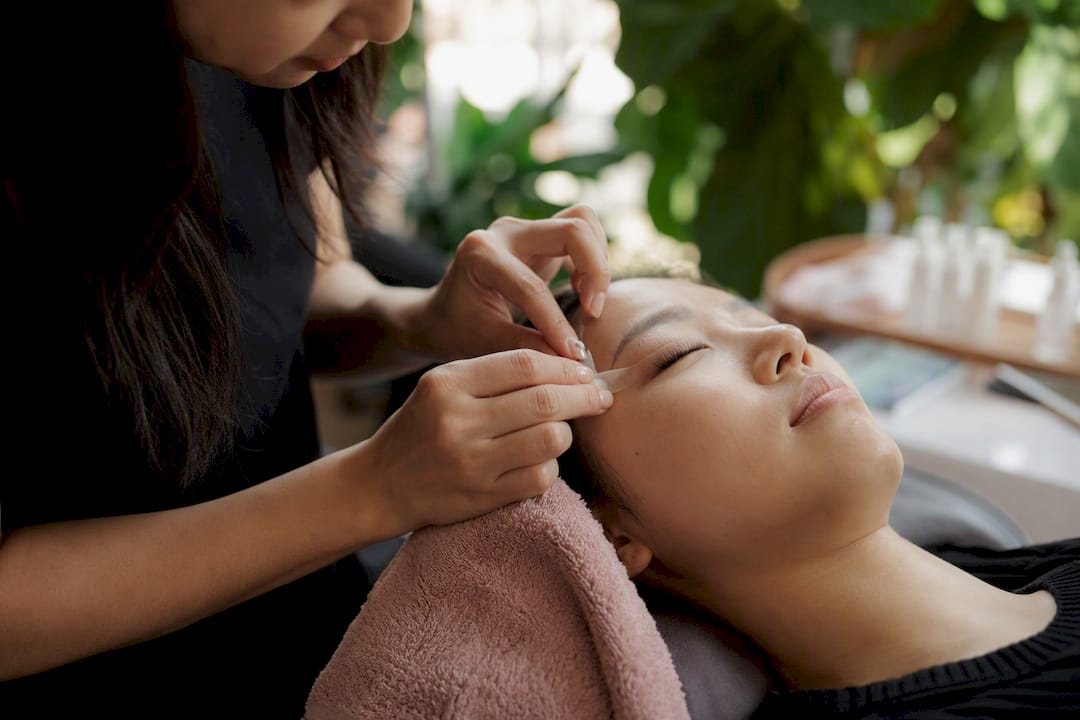
The defining feature of a Korean lash lift is its two-step processing method. Step one uses a flat shield pressed close to the lid, which relaxes and remaps the direction lashes grow from the root, rather than just bending the visible length. Step two moves to a curved shaping tool to set the final lift. This staged approach is why lash artists and estheticians increasingly reach for it on lash types that resist a single-step traditional perm.
Traditional lash lifts, by contrast, use one curved rod and a single processing step. You get a rounder, often more dramatic curl, but on lashes that grow stubbornly downward or sit especially fine and flat, that single step can overprocess the mid-shaft while barely touching the root. The lash bends, but the growth pattern underneath doesn't actually change.
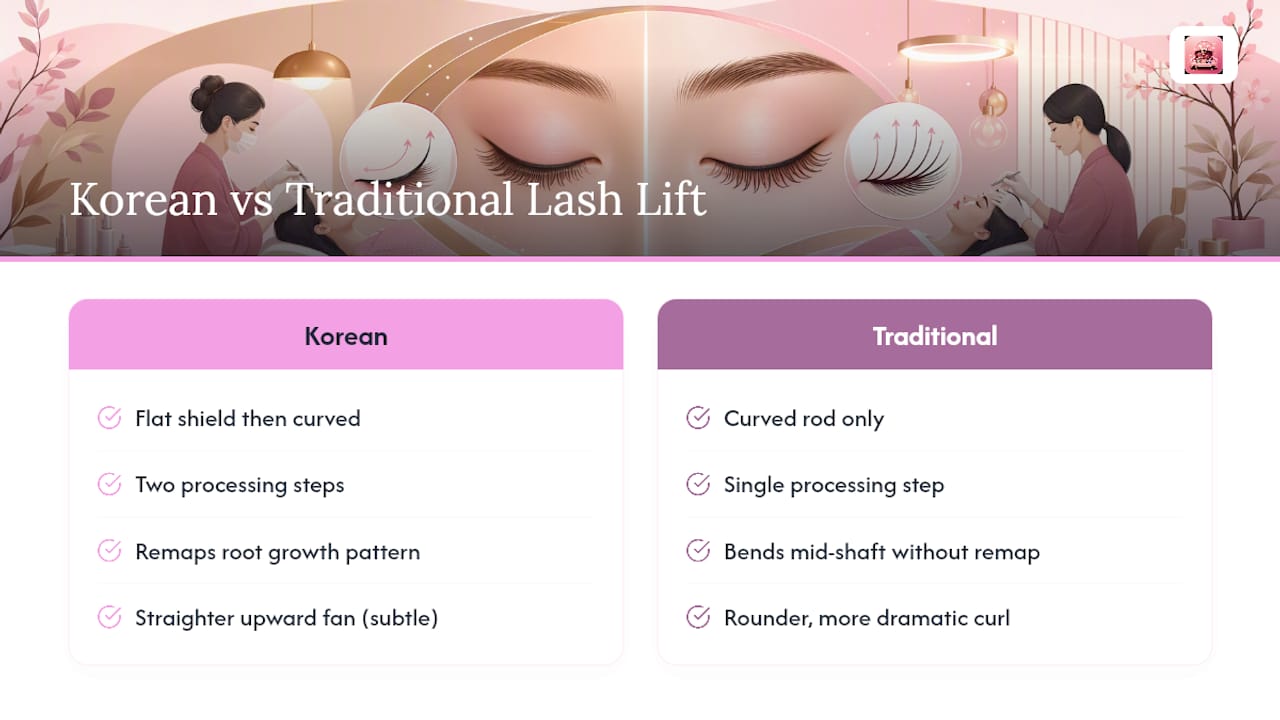
1. The technique itself. Flat shield first, curved shield second. That sequencing is the single biggest mechanical difference between the two methods, and it's the reason Korean lifts are described as "customized" rather than "curled."
2. The chemistry. Many Korean lash lift systems use cysteamine-based solutions instead of the thioglycolate found in most traditional lift kits. Cysteamine tends to process gentler and carries less of the sulfur odor associated with older thioglycolate formulas, though sensitivity can still happen with either chemistry.
3. The visual outcome. Traditional lifts deliver a tighter, rounder curl that reads more dramatic in photos. Korean lifts produce a straighter upward fan with a stronger lift at the base, which is exactly the "natural but subtle" look that's made this technique go viral.
Quick stat: Consumer reviews of the Korean lash lift put appointment time around 60 to 90 minutes, with results lasting roughly six to eight weeks. Industry comparisons note the technique can run about 60 minutes in the chair versus roughly 45 minutes for a standard single-step lift, since the two-step process simply takes longer to execute properly.
The grow-out matters too. Because a Korean lift lifts from the root rather than curling the shaft, the line between "lifted lash" and "new growth" is far less visible. Traditional lifts tend to show a harder demarcation line around week five or six, since the curl sits mid-shaft and new growth comes in straight underneath it.
Who Actually Benefits From a Korean Lash Lift?
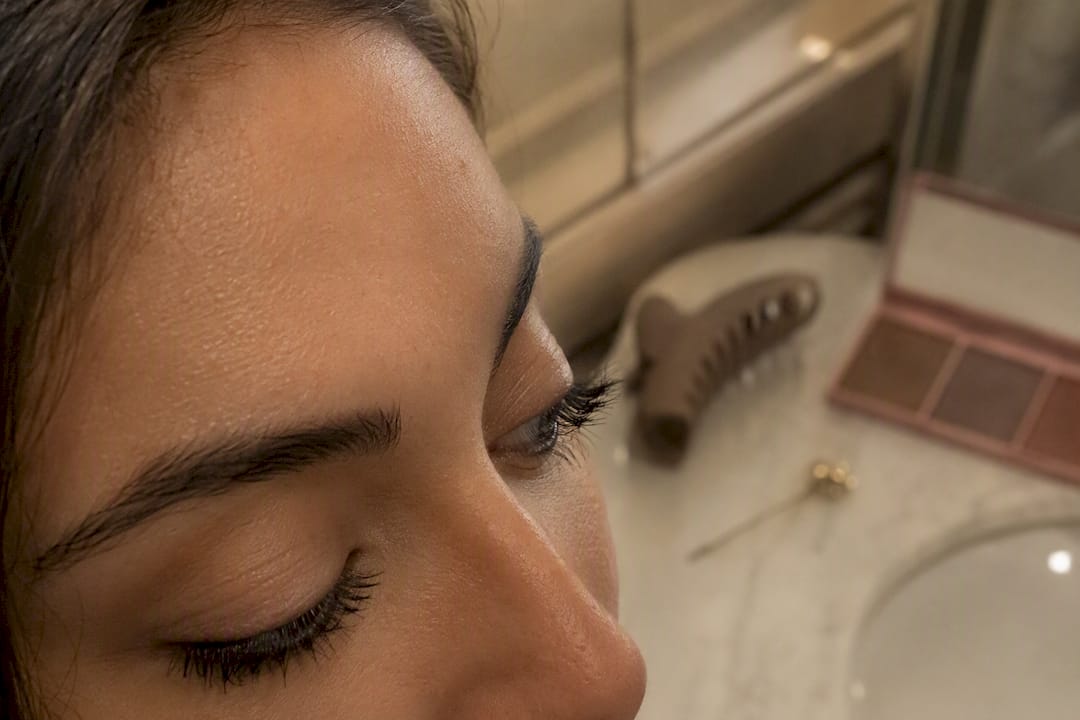
If your lashes point down instead of out, a Korean lash lift is probably the better tool for the job. This technique was built to solve exactly that problem, and it's why practitioners increasingly recommend it as a specialized fix rather than a universal upgrade.
You're likely a strong candidate if you have:
- Downward-growing or "hooded" lashes that traditional curls struggle to lift at the root.
- Fine or sparse lashes that overprocess easily under a single aggressive curl step.
- A goal of going mascara-free for weeks at a time without looking flat.
- Photography or event needs where separation and a natural fan matter more than dramatic curl.
You may be better served by a traditional lift or lash extensions if you want maximum curl height and drama, or if your lashes already respond well to a standard perm rod. There's no reason to switch a method that's already working for you.
Certain conditions are hard stops, not just cautions. Skip any lash lift, Korean or traditional, if you've had eye surgery in the past six months, have an active eye infection, or have a documented allergy to lash-lift chemical classes. A patch test 24 to 48 hours before your appointment is the simplest way to catch a reaction before it happens near your eyes.
Pro Tip: If you're not sure whether your lashes are "resistant," look at how they behave after a standard mascara curl. If the curl relaxes back down within a couple of hours, that's often a sign a single-step traditional lift won't hold either, and a Korean lift's root-level approach is worth the extra chair time.
How Does the Korean Lash Lift Procedure Actually Work?
Whether you're booking a mobile technician or eyeing an at-home kit, understanding the full sequence tells you exactly where the risk sits and why certain steps genuinely need a trained hand.
The professional workflow, start to finish
- Consultation and lash mapping. A technician examines lash length, density, and growth direction to choose the correct shield size, since the wrong flat shield can under-lift or overprocess unevenly.
- Cleansing. Lashes get cleaned of oil, mascara residue, and makeup, because any barrier on the lash shaft blocks even processing.
- Eye pad and tape placement. Under-eye pads and lid tape isolate the lower lashes and protect the skin from solution contact.
- Step one, the flat shield. The flat shield is applied at the base, and the first solution goes on to relax the root and begin redirecting growth. This stage typically runs 8 to 12 minutes depending on lash resistance.
- Step two, the shaping shield. Lashes are transferred to a curved shield sized to the desired lift, and a second solution sets the final shape. This is where a Korean lift's signature "root lift, straight fan" look actually forms.
- Optional tint. Many clients add a lash tint here to deepen color without mascara.
- Conditioning or keratin step. A nourishing treatment is often applied to offset processing stress and support lash flexibility.
- Neutralizer application. This locks in the new shape and stops the chemical process.
- Removal and aftercare briefing. Shields, tape, and pads come off, and the technician walks through the 48 hour water rule before you leave.
Total appointment time typically runs 60 to 90 minutes, depending on lash density and whether tint is added.
What an at-home kit can realistically do
A well-made kit can replicate the mechanical steps: shields, solutions, and timing charts are all included in most legitimate sets. What it can't replicate easily is judgment. Choosing the wrong shield curvature, misjudging processing time on fine lashes, or applying solution too close to the lash line are the mistakes a trained technician has already made and corrected dozens of times. At home, you're making that judgment call solo, on your own eyes, often in a mirror with worse lighting than a salon chair.
Safety checkpoints worth double-checking, whether you're watching a technician work or doing it yourself:
- Shield size matches your actual lash length, not a generic "one size fits most" assumption.
- A timer is used for every step, never a visual guess.
- Lower lashes stay fully isolated from upper lash solution.
- A patch test happened at least 24 hours before full application.
Pro Tip: Ask any technician, mobile or salon-based, how they choose shield size. A confident, specific answer, like measuring lash length and checking growth direction before selecting, is a good sign. A vague "we just use the medium one" answer is not.
Buying a Korean Lash Lift Kit: What the Label Should Tell You
If you're leaning toward DIY, the ingredient list and included tools matter more than the marketing photo. Start with the active chemistry: kits built around cysteamine tend to process gentler and smell less harsh than thioglycolate-based sets, but concentration and timing instructions still determine whether you get a soft lift or an over-processed mess.
A legitimate kit should include a real tooling checklist, not just a single shield size:
- Multiple shield sizes and curvatures, both flat (for step one) and curved (for step two).
- Under-eye pads and lash-safe tape for isolation.
- Clearly labeled solution bottles with concentration and step order marked.
- A printed or digital timing chart, not just "leave on until desired curl."
- A conditioning serum or keratin treatment for post-processing.
- Fine-tip applicators for controlled, close-to-root product placement.
Some retail kits bundle all of this into one set, which at least gives you a baseline for what "complete" looks like when comparing options.
Watch for a few red flags before you buy anything: missing active-ingredient concentrations, no clear timing instructions, no eye pads or protective isolation gear included, and vague or absent safety warnings. If a listing can't tell you what percentage of active ingredient is in the solution or how long to leave step one on before moving to step two, that's not a kit, it's a gamble.
Reality check: Consumer writeups of the professional version consistently point to comfort and natural results as the standout benefits, and part of that comfort comes from a trained hand controlling exposure time to the second. That's the exact variable that's hardest to control alone in a bathroom mirror.
Even a well-stocked kit can't replace the years of shield-selection judgment a technician builds through repetition. Cost savings are real, but so is the risk of an uneven lift, or worse, on your own lash line.
Aftercare Rules That Determine How Long Your Lift Actually Lasts
The lift itself only sets the stage. What you do in the first 48 hours, and every day after, decides whether you get the full six to eight weeks or lose the shape in three.
- Avoid water, steam, and oils for the first 24 to 48 hours. The lash bond is still stabilizing during this window, and moisture or oil can soften it prematurely.
- Skip waterproof mascara entirely. It requires oil-based removers to take off, and oil is the single fastest way to break down a lift early.
- Brush lashes daily with a clean spoolie. This keeps them separated and prevents them from setting in a clumped or crossed direction as they grow out.
- Use a lash-safe conditioning serum. A nourishing treatment applied a few times a week supports flexibility and can extend how healthy the lift looks toward week six.
- Remove makeup gently, patting rather than rubbing, especially around the lash line.
Most premature lift loss traces back to one of three things: oil contact too early, rubbing or sleeping face-down on the lashes, or a processing time that ran short during the original service. Since results typically hold six to eight weeks before fading into natural growth, book your next appointment around week seven if you want to stay ahead of the grow-out rather than reacting to it.
Pro Tip: Set a calendar reminder for week six, not week eight. Booking slightly before the lift fully drops gives your technician cleaner lashes to work with, since there's no leftover curl fighting the new shield placement.
What Are the Risks and When Should You See a Professional Instead?
Most reactions to a Korean lash lift are mild and temporary: slight tearing during processing, a little redness along the lid, or minor sensitivity that clears within hours. These are common enough that they're rarely a reason to avoid the service altogether.
More serious signs are not something to wait out. Chemical burns, persistent swelling, discharge suggesting infection, or pain that intensifies rather than fades all warrant stopping the service immediately and seeking medical attention. Practitioners note that while cysteamine-based solutions used in many Korean protocols tend to be gentler than older thioglycolate formulas, sensitivity still happens, and precise product placement near the lash line is a skill, not a given.
You should skip DIY, or at minimum insist on a patch test, if any of the following apply:
- You have a history of skin or eye allergies, especially to hair-dye or perm chemicals.
- You've had any eye surgery, including LASIK, within the past six months.
- You're using retinoids or other actives near the eye area that thin the skin.
- You've reacted to a previous lash or brow treatment, even mildly.
Worth asking: Appointment-time estimates for a full Korean lash lift run 60 to 90 minutes, which gives a technician real room to slow down, check your eyes mid-process, and adjust timing if you show any sensitivity. A rushed 30-minute version cuts that safety margin close.
Before booking anyone, ask directly about their training on the two-step method specifically, which solution brand and active ingredient they use, their patch-test policy, and how they sanitize shields between clients. A technician who answers all four without hesitation has done this enough times to know exactly why each step matters.
Why a Licensed Technician Changes the Outcome
Shield sizing is where most DIY attempts go wrong, and it's the single hardest skill to self-teach. A technician trained on the two-step method reads your lash density and growth angle, then picks a flat shield size and curvature that a generic kit simply can't customize for. That judgment call is the difference between a soft, even lift and a lash line where three lashes look great and the rest look untouched.
Timing control matters just as much. A trained eye can spot early signs of overprocessing mid-step and adjust before damage sets in, something no printed timing chart can do for you in real time. For sensitive clients, or anyone getting their first lift, that live adjustment is worth more than any savings on a kit.
VÉLOURA Beauty On Demand connects clients with licensed, background-checked beauty professionals who bring the same shield-sizing judgment and sanitation standards you'd expect from a dedicated lash studio, delivered to your home, hotel, or office instead.
Practitioners describe technique, not brand names, as the real differentiator in a well-executed Korean lash lift: proper shield selection and timing reduce clustering and create the clean separation that makes this method look natural in the first place.
The decision flow is simple. First-timer, sensitive eyes, or resistant lashes that have failed a traditional lift before? Book a professional. Confident, experienced, and buying a kit with full ingredient transparency and proper tooling? A careful DIY attempt is a reasonable choice, as long as you respect the patch test.
Our Take: Skip the Brand Hype, Focus on the Skill
The conventional advice on this technique fixates on ingredients, cysteamine versus thioglycolate, as if the chemical alone determines the result. It doesn't. Shield selection and timing control matter more than what's in the bottle, and that's a skill built through repetition, not something a product label can hand you.
Where most guides fall short is treating DIY and professional service as equally viable for everyone. They're not. A confident, experienced lash-lift user with a transparent, well-stocked kit can reasonably attempt this at home. A first-timer with resistant lashes cannot replicate the judgment a technician has built from doing this dozens of times. That gap doesn't close with a better kit.
If you take one thing from this guide, prioritize the patch test and the technician's answer to "how do you choose shield size," over the brand name on the bottle. That single question tells you more about your outcome than any ingredient list.
— VÉLOURA Beauty On Demand
Ready to Book a Korean Lash Lift That's Actually Customized to You?
Skipping the guesswork on shield sizing and processing time means skipping the salon commute too. VÉLOURA Beauty On Demand sends licensed, background-checked lash technicians directly to your home, hotel, or office, so the same judgment calls a trained pro makes in a studio happen wherever you already are, on your schedule instead of theirs.

That matters most for a technique like this one, where the difference between a soft, natural lift and an uneven one comes down to a technician reading your lash density in person, not guessing from a printed timing chart.
If you're in Los Angeles, you can see available lash technicians and book a Korean lash lift appointment directly through the app today. Not in LA? Browse VÉLOURA's full range of mobile beauty services to see what's available near you.
Sources
- My Natural Lashes Have Doubled: Why the Korean Lash Lift Is Going Viral
- What lash artists and estheticians should know about the Korean lash lift
- My Natural Lashes Have Doubled: Why the Korean Lash Lift Is Going Viral
- I Tried The Viral Korean Lash Lift — & It's Honestly Superior
FAQ
Is a Korean lash lift better than a traditional lift?
It's better for resistant, downward-growing, or fine lashes because the two-step method addresses root-level growth direction, but a traditional single-step lift can still suit lashes that already respond well to a standard curl.
What is a Korean eyelash lift, exactly?
It's a two-step lifting technique that uses a flat shield to remap lash growth from the root, then a curved shield to set the final natural-looking curl, often using gentler cysteamine-based solutions.
What are the downsides of a Korean lash lift?
It typically takes longer in the chair, around 60 to 90 minutes versus roughly 45 minutes for a standard lift, and DIY attempts carry more risk of uneven results since shield sizing requires trained judgment.
How long will a Korean lash lift last?
Results typically last six to eight weeks, fading into a soft, gradual grow-out rather than an abrupt demarcation line, provided you follow basic aftercare like avoiding water and oils for the first 48 hours.
Should I book a professional or try a kit at home?
Book a licensed technician, such as those available through VÉLOURA Beauty On Demand, if you're a first-timer, have sensitive eyes, or have resistant lashes; a careful DIY attempt is reasonable only if you're experienced and the kit includes full ingredient and timing transparency.