The six most versatile hairstyles for long hair right now are the everyday messy bun, the half-up twist, the sleek low bun, the bubble pony, the claw-clip chignon, and soft waves. According to celebrity hairstylist Laura Polko, 2026 long-hair looks center on a "hair health journey" — natural bounce and dimension over heat-heavy perfection. That shift makes these six looks especially relevant: most of them are heatless, and all of them work with your hair's natural texture rather than against it.
Here is your quick-scan reference before the full tutorials:
Pro Tip: Pick two looks from this list and practice them three times each. Repetition is what makes a style feel effortless on a rushed morning.
Key Takeaways
The most reliable approach to styling long hair in 2026 is to master three to five versatile looks, adapt them to your texture, and invest in a minimal kit of the right tools and products.
| Point | Details |
|---|---|
| Start with six go-to looks | Messy bun, half-up twist, sleek low bun, bubble pony, claw-clip chignon, and soft waves cover everyday and formal needs. |
| Adapt for your texture | Fine hair needs light mousse and teasing; coily hair needs moisture and leave-in cream before any style. |
| The right cut does half the work | Long layers with blunt ends, like the Dakota cut, add movement and make updos hold better across all textures. |
| Prep is what makes styles last | Wash every 2–3 days, detangle from ends to roots on damp hair, and apply heat protectant before any hot tool. |
| Book a pro for high-stakes events | For weddings, galas, or photo-ready occasions, VÉLOURA Beauty On Demand sends licensed stylists directly to your location. |
Table of Contents
- Step-by-step everyday hairstyles for long hair you can do in under 10 minutes
- Formal and event-ready long-hair looks with short how-tos
- Braids and updos every long-hair wearer should master
- Tools and products that make long-hair styling easier and faster
- How to adapt each look for your hair texture and thickness
- Haircut choices that make long-hair styling easier
- When should you DIY and when should you book a pro?
- Quick hairstyles for rushed mornings and last-minute occasions
- How to prep long hair before styling
- The hair health trend is the real story for 2026
- Your look deserves a professional finish for the moments that matter
- Sources
- FAQ
Step-by-step everyday hairstyles for long hair you can do in under 10 minutes
These tutorials are built for real mornings. No salon tools required, no advanced skill assumed.
Messy bun (2–3 minutes)
- Flip your head forward and gather hair into a high ponytail.
- Twist the length loosely once around the base.
- Secure with a soft elastic, leaving the ends out.
- Pull a few face-framing pieces loose with your fingertips.
Pro Tip: Spray a little dry shampoo at the roots before you start. It adds grip and cuts down on slippage throughout the day.
Half-up twist (3–4 minutes)
- Take two sections from each temple.
- Twist each section back toward the crown.
- Join both twists at the center and secure with a small claw clip or bobby pin.
- Loosen the twists slightly for a softer finish.
A silk scrunchie at the join gives this look a polished, intentional feel. For frizz-prone hair, smooth a pea-sized amount of light cream over the top sections before twisting.
Claw-clip chignon (under 1 minute)
Twist your length into a low shell shape at the nape, then press one large claw clip over the coil to lock it in place. This technique creates a polished, voluminous updo in seconds without a single pin.
Low pony with hidden tuck (4–5 minutes)
- Pull hair into a low ponytail and secure with an elastic.
- Split a small opening above the elastic.
- Flip the tail up through the opening and pull down gently.
- Smooth the top with a boar-bristle brush.
Bubble pony (5–8 minutes)
- Start with a mid-height ponytail secured with a clear elastic.
- Add elastics every 2–3 inches down the length.
- Gently pull each section outward between elastics to create the bubble effect.
Boho braids, adorned low ponies, and bubble ponies all keep hair off the face and translate across textures, making the bubble pony a reliable go-to for warm-weather days.
Loose three-strand braid (5–6 minutes)
- Detangle and part hair as desired.
- Divide into three equal sections.
- Cross right over center, then left over center. Repeat to the ends.
- Secure with a small elastic and gently pull each section wider for a fuller look.
Pro Tip: Braid on slightly damp hair that has a texturizing spray worked through it. The texture gives the braid grip and keeps it from unraveling.
Formal and event-ready long-hair looks with short how-tos
When the occasion calls for something elevated, these styles deliver. Each one includes a difficulty tag so you can decide whether to DIY or call in a pro.
Sleek low bun — DIY-friendly
- Smooth hair back with a fine-tooth comb and a light hold cream.
- Gather at the nape and twist into a tight coil.
- Secure with bobby pins tucked under the coil, not through it.
- Finish with a light-hold hairspray to tame flyaways.
Occasions: corporate events, date nights, rehearsal dinners.
Classic chignon — DIY-friendly
- Create a low ponytail and divide into two sections.
- Twist both sections around each other, then coil the result into a knot.
- Pin with U-pins around the perimeter.
- Mist with medium-hold spray.
Twisted low bun — DIY-friendly
- Part hair down the center and create two loose rope twists.
- Cross the twists over each other at the nape.
- Coil the combined twist into a bun and pin.
Braided updo — Pro recommended for weddings
- Dutch or French braid from the crown toward the nape.
- Coil the braid's tail into a bun and pin.
- Pull a few face-framing pieces loose.
- Secure with strong-hold pins and finish spray.
Pompadour-inspired sweep — Medium / pro recommended for formal events
- Tease the crown section lightly for volume.
- Sweep the top back and pin at the crown using a bump technique for lift.
- Gather the remaining length into a low twist or bun.
Embellished low pony — DIY-friendly
- Pull hair into a sleek low ponytail.
- Wrap a thin section of hair around the elastic to conceal it; pin underneath.
- Slide a jeweled clip or ribbon at the base.
Pro Tip: For any formal look, apply a light-hold hairspray 30 minutes before the event, then mist again right before you leave. Two thin layers hold longer than one heavy coat and won't leave your hair stiff.
For second-day formal hair, a spritz of dry shampoo at the roots and a fresh pin placement can revive most of these looks in under five minutes.
Braids and updos every long-hair wearer should master
A handful of foundational techniques unlocks dozens of combinations. Master these four and you can build almost any look in this article.
French braid
- Gather a section at the crown and divide into three strands.
- Cross the right strand over the center.
- Cross the left strand over the center.
- Before the next cross, add a thin section of hair from the right side into the right strand.
- Repeat on the left. Continue adding hair with each cross until you reach the nape.
- Braid the remaining length normally and secure.
Common issue: Braid loosening near the crown. Fix: keep consistent tension from the very first cross, and braid slightly tighter at the top than at the ends.
Fishtail braid shortcut
- Split hair into two equal sections.
- Pull a thin strand from the outer edge of the right section and cross it to the left.
- Pull a thin strand from the outer edge of the left section and cross it to the right.
- Repeat, keeping strands thin for a detailed pattern.
The thinner each strand, the more intricate the result. Pause after step 3 to practice the motion before committing to the full length.
Twisted crown
- Part hair down the center.
- Take a section from the left temple and rope-twist it back toward the crown.
- Pin at the crown.
- Repeat on the right side, overlapping the first twist.
- Tuck the ends under and pin.
Claw-clip chignon (refined)
Twist the full length into a low shell at the nape, press a large claw clip over the coil, and adjust the "wings" of the coil for volume. Done in seconds, it reads as intentional and polished.
Pro Tip: Keep tension even but never tight. Styles that pull at the hairline repeatedly can cause traction stress over time. If you feel pulling at the temples, loosen the section before pinning.
For video references, search each technique by name on YouTube. Pause at the point where you add hair (step 4 of the French braid) and practice that motion five times before continuing.
Tools and products that make long-hair styling easier and faster
You do not need a full kit. A focused set of the right tools and product types covers almost every look in this article.
Essential tools
| Tool | Best for | Time-saving tip |
|---|---|---|
| Boar-bristle brush | Smoothing, distributing natural oils | Use before any sleek style to cut product use |
| Wide-tooth comb | Detangling wet hair | Start at ends, work upward to prevent breakage |
| Large claw clip | Quick updos, half-ups | One clip replaces 10 pins for casual looks |
| Spiral hair ties | Braids, ponytails | Leaves no crease; safe for overnight styles |
| 1.25-inch curling wand | Soft waves, defined curls | Wrap loosely and leave ends out for natural finish |
| Flat iron | Sleek styles, twist prep | Use on dry hair only; always apply heat protectant first |
Product types and when to use them
Dry shampoo: Apply at the roots on day-two or day-three hair, wait 60 seconds, then massage in. It adds grip for updos and revives volume without washing.
Texturizing spray: Mist through mid-lengths and ends before braiding or creating a messy bun. It gives hair the "grip" that makes styles hold without pins.
Heat protectant: Apply to towel-dried or dry hair before any hot tool. A thermal protectant rated to at least 450°F covers most styling tools.
Smoothing cream: Work a pea-sized amount through the mid-lengths before sleek styles. Too much weighs hair down; less is almost always better.
Light-hold hairspray: The finishing layer for formal looks. Medium-hold for everyday styles that need to move naturally.
Silk accessories and heatless overnight techniques extend style longevity and reduce frizz, making them worth adding to your kit even if you rarely use heat.
Pro Tip: Style on hair that is about 80% dry rather than fully dry. Slightly damp hair is more pliable, holds a shape better, and means you spend less time fighting with it.
How to adapt each look for your hair texture and thickness
The same technique works differently depending on what you are working with. Here is what to adjust.
Straight hair
Straight hair holds sleek styles well but can look flat in loose braids. Add a light texturizing spray before braiding to create grip. For waves, use a 1.25-inch wand and wrap loosely, leaving the ends free for a natural finish. Styling trends now favor natural textures and ethereal waves over engineered blowouts, so embrace the slight imperfection.
Pro Tip: Straight hair tends to slip out of updos. A light mist of hairspray on the section before pinning gives it the texture it needs to stay put.
Fine hair
Fine hair benefits most from layers placed at the crown to create lift. Use a light mousse on damp hair before blow-drying to build body. Avoid heavy creams; they weigh fine strands down quickly. Bubble ponies and half-up styles work especially well because they create the illusion of volume without adding product bulk.
Pro Tip: Tease the crown section very lightly with a fine-tooth comb before any updo. Two or three gentle backcombs at the root add the volume that makes a bun look full rather than flat.
Wavy and loose-curl hair
Wavy hair is the most forgiving texture for braids and loose styles. Scrunch in a light curl cream on damp hair, let it air-dry, and most braided or twisted looks will hold without any additional product. For frizz, swap a regular towel for a microfiber cloth when drying.
Pro Tip: Braid wavy hair slightly looser than you think you need to. As it dries, the wave pattern tightens the braid naturally, and a braid that starts too tight ends up pulling.
Tight curl and coily hair
Coily hair holds braided updos beautifully but needs moisture first. Apply a heavier leave-in cream or butter before styling, and work in sections. Stretch the hair gently before braiding to reduce tension on the scalp. Protective styles like twisted crowns and braided updos are especially well-suited to this texture.
Pro Tip: Style on freshly washed, conditioned hair for the cleanest result. Coily hair that is dry or product-heavy before styling tends to frizz at the hairline within hours.
Thick and coarse hair
Thick hair can feel unmanageable in updos, but the right cut solves most of that. Ask your stylist for interior layers that remove bulk without reducing length at the ends. For braids, divide into slightly more sections than the tutorial calls for, then combine them. This gives you more control over tension and keeps the style from looking overstuffed.
Pro Tip: Use a smoothing cream on the top layer only before sleek styles. Applying it throughout thick hair often makes the mid-lengths too heavy to hold a shape.
Haircut choices that make long-hair styling easier
The right cut does half the work before you even pick up a clip.
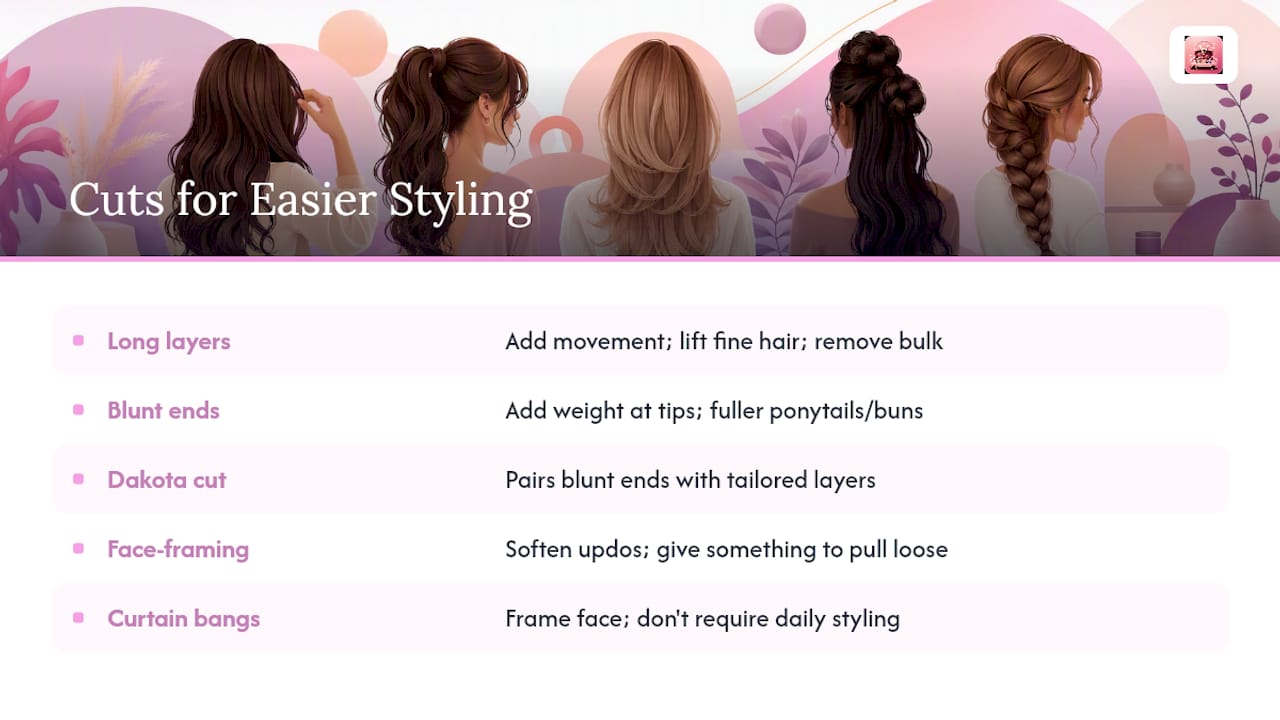
Long layers add movement and make braids, waves, and updos look intentional rather than flat. Long layered haircuts work across all textures: they add lift to fine hair when placed at the crown and remove bulk from thick hair when cut through the interior.
Blunt ends give the hair weight and density at the tips, which makes ponytails and low buns look fuller. The Dakota cut — a top 2026 salon request — pairs blunt ends with tailored layers to create exactly this combination of density and movement. Stylist Marc Ballance recommends asking for "fuller, denser shapes" with layers tailored to your face shape so the result is both manageable and flattering.
Face-framing pieces are the single easiest upgrade. A few shorter layers cut around the face soften any updo and give you something to pull loose for a more relaxed look.
Curtain bangs frame the face without requiring daily styling. They blend into the rest of the length when pinned back and add softness when worn down.
V-cut or soft-angled hems create natural movement at the ends, which makes loose waves and braids look more dimensional.
Pro Tip: When booking your next cut, say exactly this: "I want long layers that start at the collarbone and blend to my natural ends, with the weight kept at the tips." That phrasing tells your stylist you want movement without losing density, which is the most common fear with long layers.
A good cut also supports heatless styling. Hair with the right layers air-dries into a shape that works, which means fewer tools and less time.
When should you DIY and when should you book a pro?
Most everyday and quick styles are well within reach at home. The decision shifts when the stakes go up.
- Event scale: A casual dinner or office day? DIY. A wedding, black-tie gala, or event where you will be photographed? Book a pro.
- Desired complexity: Braided updos with extensions, multi-piece pinned styles, or anything requiring a mirror you cannot see? A licensed stylist delivers a cleaner result.
- Time available: If you have under 20 minutes and need a polished look, a professional saves you the stress of a rushed attempt.
- Hair condition: Damaged, color-treated, or very fine hair benefits from a professional's product knowledge and gentler technique.
- Photos vs. casual: Camera-ready styling for portraits or video requires a level of finish that is hard to achieve solo.
On-demand professional styling removes the commute entirely. A licensed stylist arrives at your home, hotel, or venue with the tools and products already packed. For bridal and event styling, VÉLOURA Beauty On Demand's wedding services cover the full party, from the bride's updo to bridesmaids' blowouts, all coordinated through one booking.
What makes a style pricier: accessories like extensions or hairpieces, travel to a venue outside standard service areas, and complex multi-piece pinned styles that take significantly longer.
Pro Tip: Before a stylist arrives, wash and blow-dry your hair to about 80% dry. Have your accessories, pins, and any reference photos ready. This alone can cut 15–20 minutes from the appointment and keeps the focus on the styling itself.
Quick hairstyles for rushed mornings and last-minute occasions
When you have five minutes or less, these are the looks that reliably deliver.
The claw-clip chignon is the fastest polished option available. Twist, clip, done. It works on second-day hair and looks intentional even when it took 30 seconds.
The scrunchie-less low bun takes about two minutes. Gather hair at the nape, twist it into a coil, and tuck the ends under. Secure with two crossed bobby pins. No elastic needed, no crease left behind.
The tall topknot works on any texture. Pull hair straight up to the crown, twist once, and secure with a large elastic. Pull the bun slightly apart for volume. This is the style to reach for when your hair is not cooperating with anything else.
The half-up claw clip is the most forgiving option. Take the top half of your hair, twist it loosely, and clip. It takes under a minute and pairs with any outfit. Editors at Marie Claire consistently recommend this as a go-to for effortless polish.
For beach days or casual summer outings, a quick beach-ready updo pairs naturally with these styles, keeping hair off your neck without sacrificing the look.
The key to all of these: keep a large claw clip and a small elastic on your nightstand or in your bag. Having the right tool within reach is what makes a two-minute style actually happen.
How to prep long hair before styling
Good prep is what separates a style that lasts all day from one that falls apart by noon.
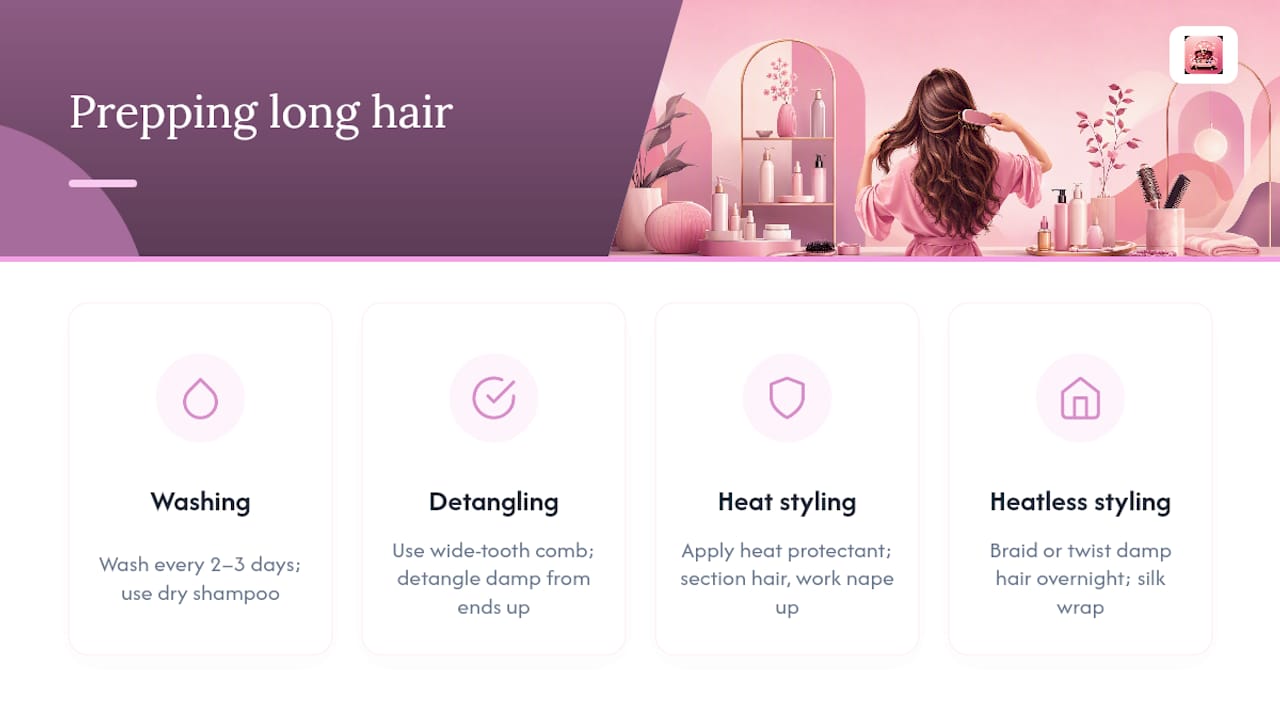
Washing frequency matters more than most people realize. Washing every 2–3 days rather than daily preserves the natural oils that give hair grip and shine. On non-wash days, dry shampoo at the roots refreshes volume and extends the life of any style. Garnier's long-hair guidance reinforces buns and ponytails as reliable go-tos precisely because they work best on hair that has a day or two of natural texture built in.
Detangling technique is where most breakage happens. Always detangle on damp, conditioned hair. Start at the ends with a wide-tooth comb and work upward in small sections toward the roots. Never drag a brush through dry, tangled hair from root to tip. For very thick or coily hair, apply a leave-in conditioner before combing.
Before heat styling: apply heat protectant to dry or towel-dried hair, section the hair before you start, and work from the nape upward. Sectioning takes an extra two minutes but cuts total styling time significantly because you are not re-doing sections.
Before heatless styling: braid or twist on damp hair and leave overnight. The result in the morning is waves or texture that holds without any tool. A silk pillowcase or silk hair wrap reduces frizz while you sleep, which is especially useful for fine or color-treated hair. Supporting your hair's overall health with a consistent routine, including a quality hair vitamins serum, can also improve the texture and manageability you are working with every day.
The hair health trend is the real story for 2026
The most interesting shift in long-hair styling right now is not a new technique. It is a change in what "good hair" means.
For years, the benchmark was a perfect blowout: smooth, uniform, high-shine. That standard required heat almost every day, and it quietly worked against the hair it was meant to showcase. The 2026 trend is a direct correction. Natural bounce, visible texture, and dimension are now the goal. Soft waves that look like they happened, not like they were engineered. Braids that are slightly imperfect. Updos that feel lived-in.
This is genuinely good news for anyone with long hair. It means the styles that are easiest to do are also the ones that look most current. A messy bun done well is more on-trend than a rigid chignon that took 45 minutes. A loose braid with a few pieces pulled out reads as intentional, not unfinished.
The practical takeaway: choose two or three looks you can execute reliably, and practice them until they feel automatic. One versatile everyday style, one quick formal option, and one heatless wave technique covers almost every occasion. That is a more useful approach than chasing a new look every week.
Pro Tip: A single well-placed accessory, like a sculptural claw clip or a thin gold barrette, can make the same basic bun look casual, polished, or formal depending on placement. One accessory, three contexts.
Your look deserves a professional finish for the moments that matter
Everyday styles are yours to own. But for a wedding, a milestone event, or any occasion where you want to feel genuinely taken care of, a licensed stylist changes everything.
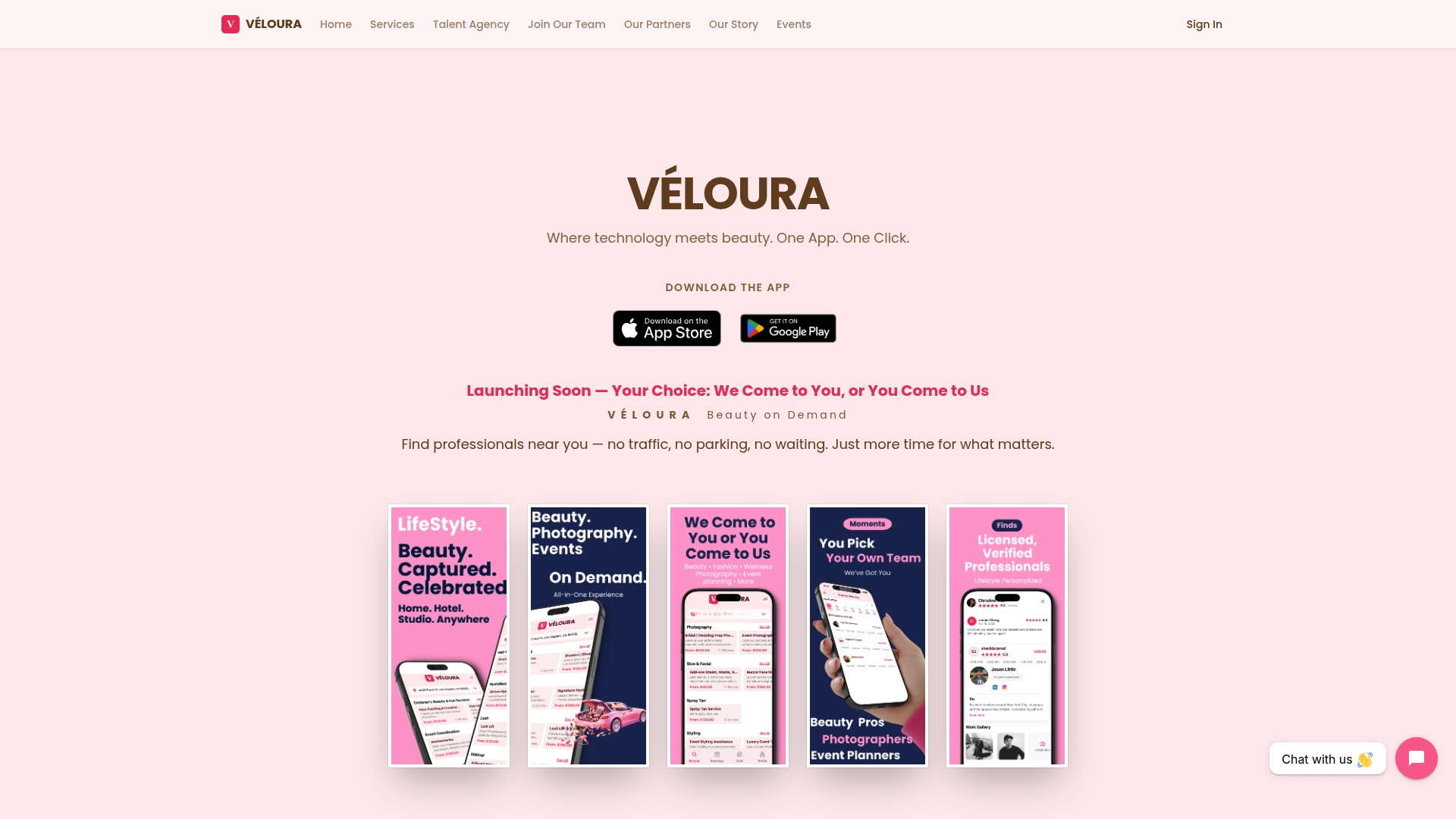
VÉLOURA Beauty On Demand connects you with vetted, licensed hair professionals who come directly to your home, hotel, or venue. No commute. No salon wait. Just a calm, focused appointment built around your schedule. Whether you need a bridal updo, a blowout before a big meeting, or a full event-party style session, book on-demand hair services in New York City, Los Angeles, or Miami through the VÉLOURA app. For bridal and event bookings, visit the VÉLOURA wedding services page to check availability and get your look locked in.
Sources
- Long hair trend 2026 — Harper's Bazaar
- 8 easy-to-recreate summer hairstyles that are chic, low-maintenance and work for all hair types — Cosmopolitan
- 10 Easy Hairstyles for Long Hair You Can Do in Minutes (Blissy blog)
- 7 easy hairstyles that look effortlessly chic, per editors — Marie Claire
- 35 long layered haircuts for an instant refresh — Southern Living
- Long hair haircuts gallery and trend notes — Glamour
FAQ
What haircut looks best on long hair?
Long layers with blunt ends, like the Dakota cut, are the top 2026 salon request because they add movement and density without sacrificing length. Ask your stylist for layers starting at the collarbone with weight kept at the tips.
What is the current trend for long hair in 2026?
The dominant trend is the "hair health journey": natural bounce, visible texture, and soft waves over heat-heavy, overly polished styles. Lightweight texturizing and heatless techniques are the preferred methods.
What are the fastest hairstyles for long hair?
The claw-clip chignon, scrunchie-less low bun, and half-up claw clip can all be done in under two minutes and look polished enough for most occasions.
When should you book a professional stylist instead of DIYing?
Book a pro for weddings, galas, or any event where you will be photographed. VÉLOURA Beauty On Demand sends licensed stylists to your home, hotel, or venue so you get a photo-ready finish without the salon commute.
What should women over 50 do with long hair?
Soft layers, face-framing pieces, and curtain bangs work especially well for long hair at any age because they add movement and soften the face without requiring daily heat styling. A low bun or loose waves are polished, low-effort choices that hold up throughout the day.