Most cosmetic surgery recovery follows a predictable arc: discomfort and swelling peak around 48 to 72 hours, early improvement shows up within 1 to 2 weeks, routine activities return in 2 to 6 weeks, and final results settle in over several months. The three moves that matter most right now are: follow your surgeon's specific plan over any generic timeline, arrange caregiver support for at least the first 48 to 72 hours, and know your red-flag symptoms before you need them. Scar care and sun protection stay relevant for months after everything else feels normal.
TL;DR:
- Most recovery times vary by procedure, with minor surgeries like liposuction taking 3 to 6 months to fully settle, while more extensive surgeries may take up to a year.
- The first 72 hours require careful preparation, including medication, caregiver support, and supplies, to manage pain and prevent complications effectively.
- Swelling and inflammation typically peak on days 2 to 3, making day three the hardest, but this is a normal part of the healing process.
- Warning signs such as sudden worsening pain, unusual drainage, leg pain, or fever above 101°F should prompt immediate contact with your surgeon.
- Light movement starting day 1 reduces clot risk, but strenuous activity and exercise should generally wait until cleared by your surgeon, usually after 4 to 6 weeks.
Table of Contents
- Your First 72 Hours: A Quick Recovery Checklist
- How Long Does Cosmetic Surgery Recovery Take by Procedure?
- Managing Pain Without Overusing Medication
- Caring for Incisions, Drains, and Scars
- When Can You Walk, Drive, and Return to Exercise?
- Warning Signs That Mean You Should Call Your Surgeon
- Setting Up Your Home for the First Week
- Where Nonclinical Comfort Support Fits During Recovery
- Comfort Care That Comes to You During Recovery
- Sources
- FAQ
Your First 72 Hours: A Quick Recovery Checklist
The first three days set the tone for everything after. Get these pieces in place before surgery day, not after.
Supplies to have ready:
- Prescribed pain medication plus acetaminophen, filled and in hand before your procedure
- Loose, front-button or zip clothing you can get in and out of without raising your arms
- Extra pillows for positioning and elevation
- A thermometer, gauze, and any dressing supplies your surgeon lists
Caregiver tasks to assign:
- Someone who can stay with you for the first 48 to 72 hours, since most patients need real hands-on help managing medication and basic needs during that window, according to a caregiver-support study.
- A backup driver for follow-up appointments in case your primary caregiver has a scheduling conflict.
Pro Tip: Set phone alarms for your medication schedule before surgery day. Post-anesthesia grogginess makes it easy to lose track of when you last took something, and doubling up or skipping doses both cause avoidable problems.
How Long Does Cosmetic Surgery Recovery Take by Procedure?
Recovery length depends heavily on which procedure you had, how much tissue was affected, and whether multiple procedures were combined. The numbers below are averages drawn from clinical guidance, not a substitute for your surgeon's specific plan.
| Procedure | Acute phase (peak symptoms) | Early milestone | Back to desk work | Final results |
|---|---|---|---|---|
| Facelift / blepharoplasty | Swelling and bruising peak days 2–3 | Most bruising fading by day 14 | 10 days | 2–6 months |
| Breast augmentation, lift, or reduction | Tightness and soreness peak days 2–3 | Arm mobility improving by week 1–2 | 1–2 weeks | 3–6 months |
| Tummy tuck (abdominoplasty) | Significant swelling, drains in place days 1–5 | Upright walking comfortable by week 2 | 2–3 weeks | 6–12 months |
| Liposuction | Bruising and soreness peak days 2–3 | Compression garment routine by week 1 | 3 days | 3–6 months |
| Combined procedures | Extended acute phase, days 3–5 | Milestones shift later than single-procedure norms | 2–4 weeks | 6–12 months |
Recovery unfolds in overlapping phases: immediate (0 to 48 hours), early (1 to 2 weeks), mid (2 to 6 weeks), and late (2 to 12 months), according to The Well by Northwell. Final results for most procedures take six months to a year to fully settle as swelling resolves and scars mature, The Aesthetic Society notes. If your procedure combined two or more surgeries, plan for the longer end of every range.
Managing Pain Without Overusing Medication
Pain intensity almost always follows the same curve: it's worst in the first 48 to 72 hours, then eases steadily from there. If day three feels like the hardest day, that's not a sign something went wrong. Swelling typically peaks at that exact point, and inflammation drives pain right alongside it.
Most surgeons build a multimodal plan rather than relying on one medication:
- Take prescribed pain medication on a schedule for the first 2 to 3 days, then shift to as-needed dosing once discomfort eases.
- Layer in acetaminophen between doses of stronger medication, as directed by your surgeon.
- Use ice packs and elevation for the first 48 hours to reduce swelling alongside medication.
- Skip NSAIDs and aspirin unless your surgeon specifically clears them. Both increase bleeding risk during a critical healing window, a concern echoed in guidance on post-operative medication choices.
- Avoid alcohol entirely while taking prescribed pain medication.
Call your surgeon if pain suddenly spikes after it had been improving, or if scheduled medication stops controlling it. That pattern often signals something worth checking, not just a bad day.
Caring for Incisions, Drains, and Scars
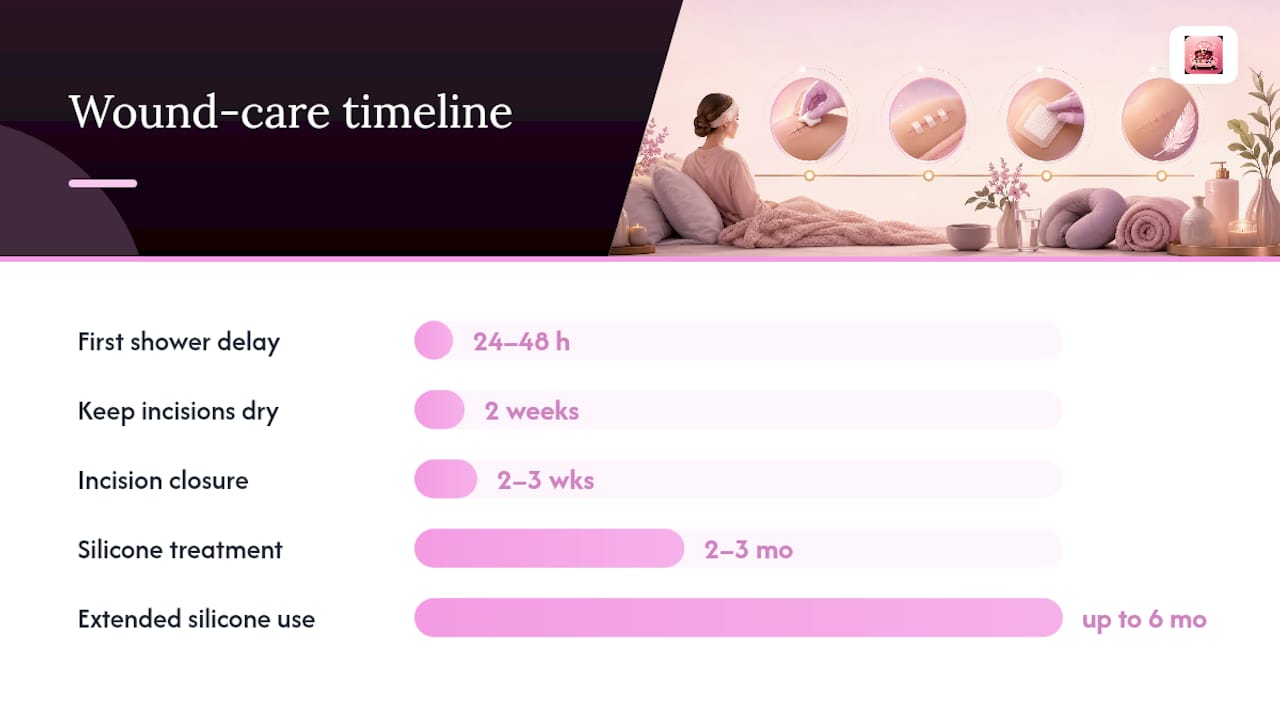
Wound care in the first two weeks is mostly about keeping incisions clean and dry until your surgeon clears showering. Most practices ask patients to wait 24 to 48 hours before the first shower and to pat, never rub, incision lines dry afterward.
If you have surgical drains, your caregiver should track output several times a day. Recording drain output 3 to 4 times daily and watching for sudden increases helps catch a seroma or bleeding early, according to UCLA Health's post-operative guidance. Drains typically come out once daily output drops below a threshold your surgeon sets; exact amounts vary by case.
Once your incision has fully closed, usually around 2 to 3 weeks, scar management becomes the long game:
- Begin silicone gel or sheets only after the incision has closed, since applying them too early can interfere with wound closure, per ASPS guidance.
- Wear silicone sheets 12 to 24 hours daily for at least 2 to 3 months. Many patients continue for up to 6 months for the best fade.
- Avoid direct sun exposure on scars for several months, since UV exposure can cause permanent discoloration that never fully corrects, the ASPS also confirms.
- Once cleared for sun exposure, use a high-SPF mineral sunscreen on any visible scar year-round, not just in summer.
A partner resource on early aftercare after skin procedures covers similar first-48-hour protection principles worth reviewing if your procedure included any skin resurfacing.
When Can You Walk, Drive, and Return to Exercise?
Movement matters more than most patients expect. Early ambulation, meaning short, frequent walks starting day 1 or 2, is one of the simplest proven ways to lower your risk of deep vein thrombosis, according to research on post-operative mobility.
- Days 1 to 2: Take short, slow walks around the house every few hours. Skip anything that raises your heart rate.
- First 1 to 2 weeks: Avoid long-haul flights or road trips unless your surgeon clears travel, since prolonged sitting raises clotting risk right when you're most vulnerable.
- Before driving: Wait until you're fully off sedating pain medication and confident you could react to a sudden stop or swerve.
- Week 2 to 4: Light desk work often resumes here, procedure depending, once swelling and pain allow normal sitting.
- Week 4 to 6+: Resume strenuous exercise only after surgeon clearance. Build back gradually, starting with walking, then light cardio, then strength training.
Compression garments support this whole stretch. They reduce swelling and help skin contour to its new shape after body procedures, and a clinical overview of compression therapy breaks down how that mechanism works if you want the deeper explanation.
Warning Signs That Mean You Should Call Your Surgeon
Most recoveries stay on the expected track. When something falls outside it, catching it early is what keeps a minor issue from becoming a major one.
- Fever above 101°F, especially paired with chills or feeling generally unwell.
- Pain or swelling that suddenly worsens after it had been improving, rather than following the normal gradual fade.
- Drainage that turns cloudy, yellow, green, or foul-smelling instead of the expected pink or clear fluid.
- New leg pain, swelling, or warmth in one leg, which can signal a blood clot.
- Chest pain or shortness of breath, which needs emergency care, not a scheduled callback.
Pro Tip: When you call, have specifics ready: a photo of the area, your drain output numbers if you have them, and exactly when the symptom started. Surgeons triage faster with details than with "it just feels wrong." Early, specific reporting is exactly what The Aesthetic Society points to as the habit that prevents small issues from escalating.
Setting Up Your Home for the First Week
A well-prepped home does more for your recovery than most people expect. Caregivers carry the load here: managing the medication schedule, helping with mobility, checking wounds for the changes above, and driving to follow-ups.
- Set up a recovery station within reach: pillows, phone charger, water, medications, and tissues, so you're not stretching or twisting to grab things.
- Prepare or freeze meals in advance. Cooking is the last thing you'll want to manage in week one.
- Line up pet or childcare coverage for at least the first few days, especially if lifting or bending is restricted.
- If you smoke, stop well before surgery. Nicotine is a potent vasoconstrictor that impairs healing and raises the risk of tissue damage at the incision, a risk confirmed in wound-healing research.
Expect fatigue and mood swings in the first two weeks. That dip is common, not a sign of a poor outcome, and it usually lifts as pain eases and mobility returns. If low mood persists past two to three weeks, mention it to your surgeon or a mental health professional.
Where Nonclinical Comfort Support Fits During Recovery
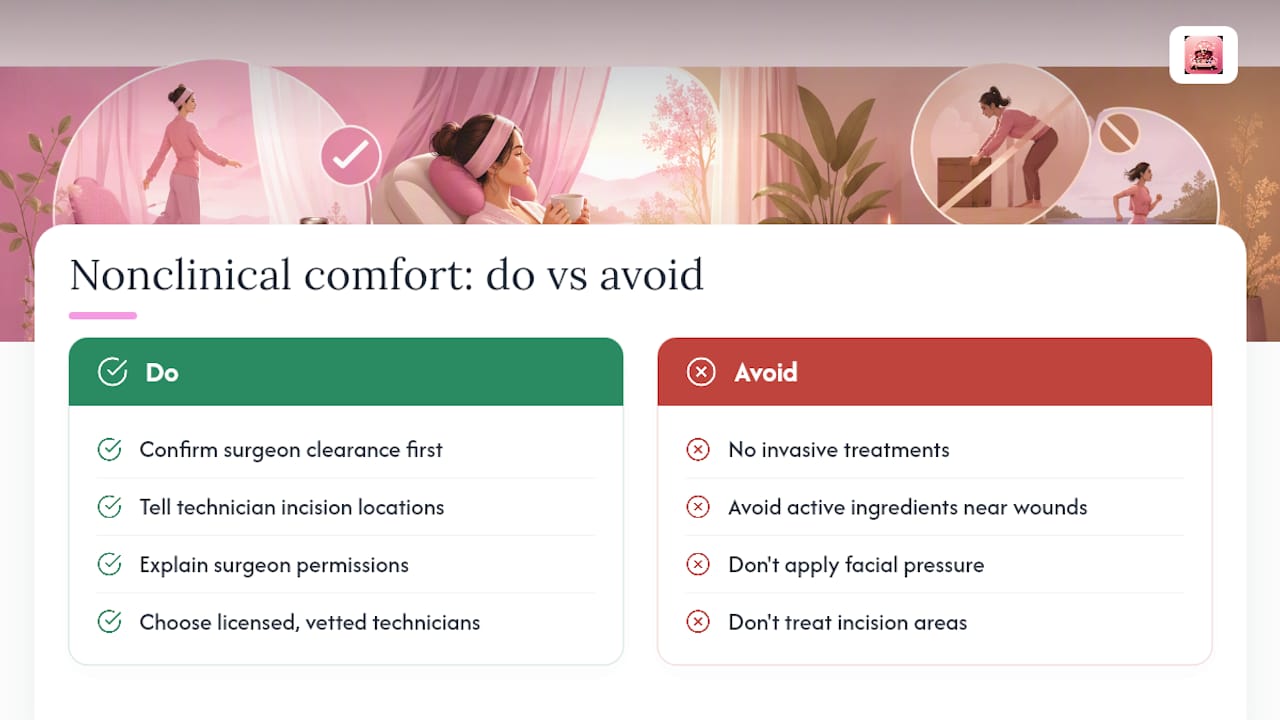
Recovery isn't only physical. Feeling presentable again, even just having clean hair or tidy nails, tends to lift mood faster than people expect once the acute phase passes. That's where nonclinical, in-home comfort services can genuinely help, provided your surgeon has cleared them first.
Gentle skincare consults, nail care that avoids incision areas entirely, and hair styling that works around dressings or limited arm mobility all fall into safe territory once cleared. What doesn't: any invasive treatment, active ingredients near healing skin, or facial pressure near recent work. VÉLOURA Beauty On Demand professionals are licensed and vetted, and every booking runs through secure, trackable payment, the same standard used across VÉLOURA's gentle skincare visits and senior care offerings.
If you book during recovery, tell your technician exactly what happened, where incisions are, and what your surgeon has and hasn't cleared. A good technician will ask before you even bring it up.
Comfort Care That Comes to You During Recovery
Getting to a salon chair three weeks post-op, arm in a sling or still avoiding long car rides, is exactly the kind of errand recovery makes miserable. That's the gap VÉLOURA Beauty On Demand fills: licensed beauty professionals who come to your home instead of asking you to come to them, with services adapted around dressings, limited mobility, and doctor's orders rather than around a salon's fixed menu.

Every booking includes background-checked professionals, secure in-app payment, and the flexibility to describe your restrictions before anyone arrives. A gentle facial through VÉLOURA's skincare services, a careful manicure that steers clear of an IV site, or a soft blowout that skips pressure on healing areas can all be requested as post-op friendly. Always confirm with your surgeon before booking anything, and mention your procedure date when you request the service so your technician can plan around it. If you're recovering in the Miami area, you can browse available appointments and book a visit for whenever you're ready to feel like yourself again.
Sources
- Cosmetic Surgery Recovery: An 8-Step Checklist | The Well by Northwell
- PMC article on immediate post-op caregiver importance
- PubMed: nicotine and wound healing risks
FAQ
How Long Does It Take to Recover From Cosmetic Surgery?
Most patients see steady improvement over 1 to 6 weeks and reach final results within 6 to 12 months, though timing varies significantly by procedure and whether multiple surgeries were combined.
Why Is Day 3 the Worst After Surgery?
Swelling and inflammation typically peak around 48 to 72 hours after surgery, which makes day three feel like the hardest point even though it's part of the expected pattern, not a complication.
What Is the Hardest Plastic Surgery Recovery?
Combined procedures and larger body surgeries like tummy tucks generally involve the longest and most demanding recovery, with drains, extended swelling, and final results taking up to a year to fully appear.
Is Plastic Surgery Getting Better?
Surgical techniques and aftercare protocols, including silicone scar management and structured week-by-week recovery plans, have made outcomes more predictable and complications less common than in years past.
Can I Get Beauty Services While Recovering From Surgery?
Nonclinical services like gentle skincare, careful nail care, and dressing-friendly hair styling can be appropriate once your surgeon clears them, and beauty professionals can adapt a visit around your specific restrictions.